Author Archives: Karam

Fire does not forget

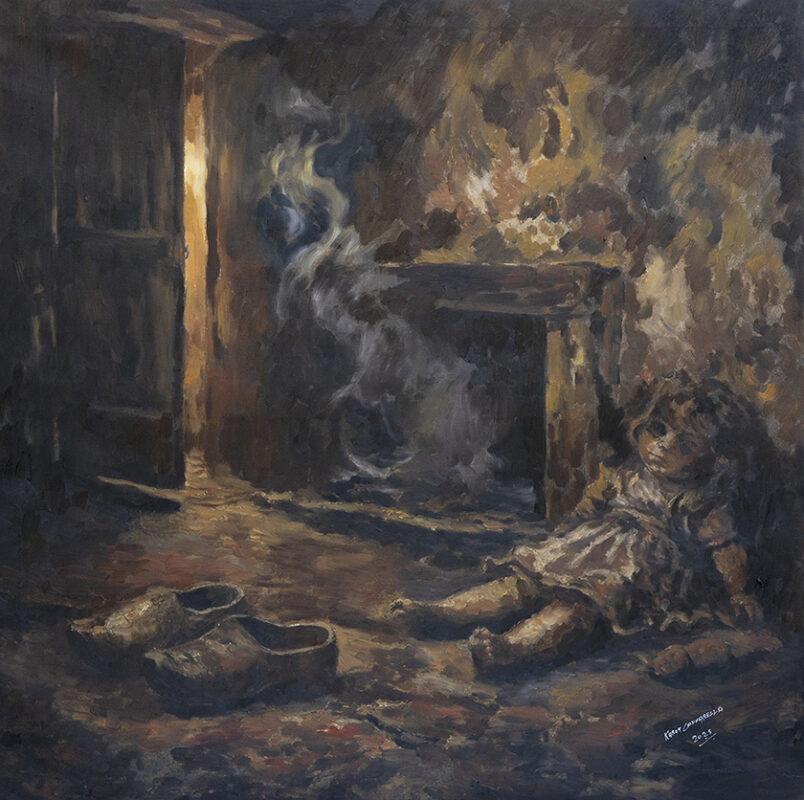
With Fire does not forget, Karam Cannarella continues the reflection begun in the Restanza cycle, venturing into a territory where memory, loss and permanence intertwine in a narration suspended between reality and vision. The work presents itself as a bare, almost abandoned interior, crossed by a subtle light that filters through the door left ajar. And yet, what emerges is not the description of a place, but the materialisation of a presence that continues to exist beyond its own absence.

At the centre of the composition there is not a human figure, but a doll forgotten on the floor. Its inert body, beside a pair of worn clogs, immediately introduces a domestic and affective dimension. They are objects that carry with them the weight of lived experience, fragments of a daily life now interrupted that the painting returns as relics of a time not completely passed. Nothing appears truly concluded: every element seems to retain the trace of those who inhabited it.

The most disturbing element of the work is, however, the evanescent presence that rises beside the table. A figure barely sketched, built through glazes and chromatic fades, emerges from the pictorial matter like a memory that refuses to disappear. It is not a ghost in the narrative sense of the term, but a condensation of memory itself. Cannarella does not represent absence; he paints its persistence.

The title orients the reading without exhausting it. The fire it alludes to is not only that of destruction, but also that of memory that keeps burning beneath the surface of time. If fire transforms everything it crosses, it nonetheless leaves traces, sedimentations, residues that resist oblivion. In this sense the work fully inscribes itself in the concept of restanza that runs through the artist’s recent research: what remains does not coincide with what survives intact, but with what continues to manifest itself in new forms, often fragile and imperfect.

The open door, recurrent in Cannarella’s most recent production, takes on a further function here. It is a threshold between the visible and the invisible, between what belongs to the present and what continues to resurface from the past. The light that filters in from outside does not dissolve the shadows; on the contrary, it makes them perceptible, giving consistency to what seemed lost.
Through a dense and atmospheric painting, made of chromatic stratifications and luminous vibrations, Fire does not forget builds an emotional space in which memory does not present itself as simple nostalgia, but as active presence.

The work invites the gaze to pause in that uncertain zone where memory continues to generate images, reminding us that some traces do not ask to be preserved: they simply do not stop existing.
The last keeper

With Restanza, Karam Cannarella inaugurates a new trajectory of his research, shifting the gaze towards a more gathered and radically essential dimension of remaining. If in previous works the figure seemed to inhabit unstable territories of identity, immersed in processes of exposure, transformation and dispersion, in this new production the tension concentrates around a more silent gesture: that of keeping.

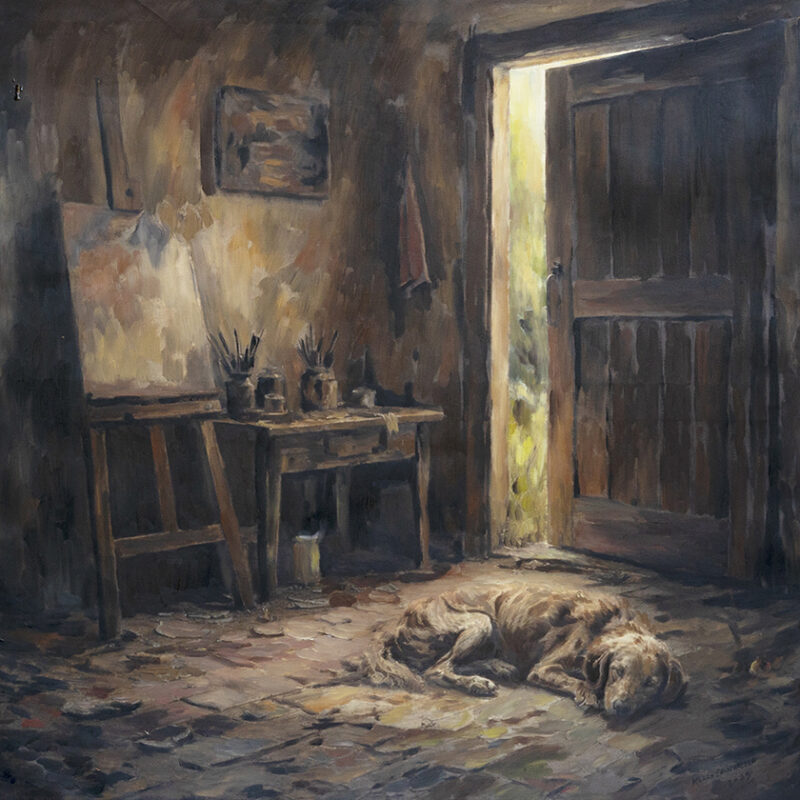
In The last keeper, painting opens onto a suspended interior, a space at once domestic and mental, crossed by traces of presence that seem to resist the erosion of time. The easel, the brushes, the worn table do not merely define a setting; they become fragments of an operative memory, clues of a doing that continues to exist even in absence. Every element appears held in a slow temporality, as if something had just happened or had yet to be accomplished.

At the centre of the work, the reclining body of the dog introduces a presence that escapes every easy allegory. A keeper, certainly, but not in the heroic or vigilant sense of the term. Its gathered posture suggests rather a quiet fidelity, a form of discreet resistance that manifests itself through waiting. It is a presence both vulnerable and necessary: it remains when everything seems to have withdrawn, it inhabits a space that no longer protects anything except the very possibility of remaining.

The door left ajar, invaded by light, organises the symbolic tension of the image. It represents neither a landing nor a promise of escape. It is an open threshold, the point where inside and outside brush against each other without resolving. In this tension the poetic core of Restanza is articulated: to remain does not mean to immobilise oneself, but to sustain the conflict between what holds and what inevitably calls elsewhere.

The concept of restanza, in Cannarella’s research, thus frees itself from every nostalgic interpretation. It does not coincide with the refusal of change, but with the choice — fragile and stubborn — to inhabit what remains without withdrawing from precariousness. The last keeper tells neither of an end nor of an abandonment; it stages rather a form of minimal and resistant presence, a condition in which even silence becomes a gesture of care.

Painting thus becomes a place of emotional sedimentation: less theatrical, more atmospheric, capable of holding light and time. In Restanza, what survives is not certainty, but the subtle relationship with what continues, despite everything, to ask to be kept.

The Queen of the labyrinth

The Queen of the Labyrinth condenses into a circular format a tension that runs through all of Karam Cannarella’s recent research: that between identity and dispersion, between presence and loss. The face emerges at the centre of the composition like a held apparition, frontally exposed to the gaze, but immediately sucked in by a pictorial vortex that seems to dissolve every possibility of stability.

The round support is not a simple formal element. It functions as a perceptual device, eliminating hierarchies and privileged directions. There is no true vanishing point: everything rotates, thickens, returns. The central figure, with the marked make-up and the almost hieratic fixity of the expression, thus takes on an ambiguous presence. A queen, certainly, but of an unstable realm, crossed by fragments, slippages, visual interferences that prevent any idea of dominion.

The labyrinth evoked by the title does not appear as an architectural space to be crossed, but as a mental and affective condition. It is an internal dimension that invests the very body of the image. Painting proceeds indeed by accumulations and chromatic collisions: rapid brushstrokes, sudden luminous openings, signs that emerge and immediately lose themselves within the matter. Nothing lets itself be fixed definitively. Even the face, though central, seems continuously to oscillate between emergence and fading.

In this work the concept of restanza, which progressively defines itself in the author’s poetics, takes on a further quality. It no longer coincides only with remaining within a threshold or a tension, but with inhabiting a complexity that cannot be recomposed. To remain thus means to accept disorientation without transforming it into trauma nor into solution. The figure does not seek an exit from the labyrinth; it crosses it by standing still, as if movement occurred all around her.

The performative component, recurrent in Cannarella’s research, here loses every narrative dimension to become pure visual intensity. The make-up, the ornaments, the theatricality of the image do not function as masks behind which to hide, but as surfaces through which the subject takes form.

It is a work that holds the gaze precisely because it refuses to give itself completely, letting emerge a presence that continues to change while we observe it.

Threshold line

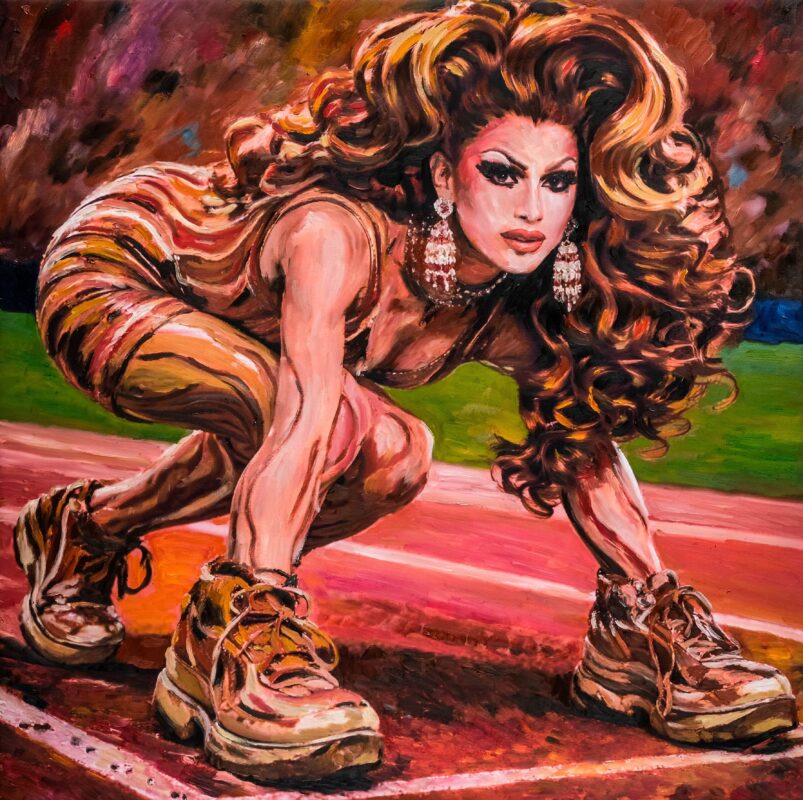
Threshold line concentrates all its energy in an instant of compression, in that moment which precedes the start but which, instead of exploding into movement, seems to hold itself back within the body. The figure crouched on the track does not simply occupy a performative space: it strains it. Every element of the image participates in this tension, from the hands resting on the ground to the twist of the legs, up to the almost excessive mass of hair that expands like an emotional extension of the gesture.

The work operates on the boundary between exposure and resistance. The posture recalls the iconography of the athletic start, but here competition loses centrality. There is no visible finish line, nor sporting dynamic. The threshold evoked by the title becomes rather an existential condition: an unstable point at which the subject is called to transform without knowing to what extent it will really be able to.

In this painting the author’s research further deepens the concept of restanza, which definitively ceases to belong to the order of theme to become embodied experience. To remain does not coincide with immobility, but with permanence within a tension that does not resolve. The figure seems ready for movement and at the same time incapable of separating from the point where it finds itself. It is precisely this contradiction that generates force.

The visual language too proceeds by accumulation and friction. Painting does not seek formal balance, but insists on the deformation of the gesture and the vibration of the surface. The lines of the track cross the picture like provisional coordinates, incapable of truly organising the space. The body, instead, emerges through continuous chromatic variations that make it unstable, almost crossed by contrasting energies.

The performative identity of the figure is not treated as a mask to be unmasked, but as an authentic place of exposure. There is no ironic distance, nor theatrical complacency. The face looks frontally, sustaining the gaze of the observer with a presence that does not ask for legitimation. In this frontality one senses an almost ritual dimension, as if the body were captured in the moment in which it attempts to redefine its own balance with respect to the world.

The thought that runs through the work too seems to move by fragments, deviations, sudden stops. Meaning is not delivered in a linear way but surfaces through successive thickenings, like something that takes form while continuously risking to disperse. Painting follows this same movement: it builds a presence and at the same time shows its precariousness.

Threshold line does not therefore tell of a completed passage, but of the permanence within its own friction. The threshold is not the point to be crossed: it is the place where the subject remains, exposes itself, continuously redefines itself. And it is precisely in this impossibility of stabilising that the work finds its most authentic intensity.

Paola Martino

Before the flight

Before the flight imposes itself as a held threshold, an image that does not tell of an event but delays it. The figure is frontal, exposed, crossed by the lines of the cage that do not merely contain it but scan its face, almost segmenting the very possibility of expression. We are not before a narrative imprisonment, but a condition that prolongs itself.

The wings, open behind the body, do not suggest impulse. They remain like an unused excess, a promise that finds no direction. The face, built through an insistent pictorial mask, does not seek empathy. It holds the gaze. In this charged immobility, the “before” evoked by the title ceases to be a moment and becomes a place.

It is here that the notion of restanza becomes more incisive than in previous works. It does not emerge as content to be recognised but as experience that deposits itself in the gaze. It is not a matter of remaining in wait for something, but of remaining within a condition that does not need to resolve. The cage is not only a limit, it is what allows this experience to happen.

The language that runs through the work too seems to function by contraction and slippage. Meaning does not offer itself in a linear way but thickens, interrupts, slides, as if it remained constantly on the threshold of its own formulation. More than declaring, it builds a held rhythm, a tension that does not dissolve and that continues to work beneath the surface of the image. In this way painting does not illustrate but exposes a thought in action, which forms and arrests itself in the same gesture.

The pictorial matter insists on this restraint. The surface does not open, does not concede depth. The colours of the wings and of the garment do not seek accord with the face, but set it in friction, as if two different regimes coexisted without finding synthesis. Everything concurs to keep active a tension that does not dissolve.

Before the flight thus marks a clear passage in the author’s research. Restanza no longer concerns only a situation or a relationship, but takes root as a condition. The flight loses importance, almost becomes secondary. What matters is this standing before, this remaining within a time that does not proceed. Not as a block, but as a form of experience that continues to produce meaning precisely because it does not let itself be accomplished.

Assisted descent

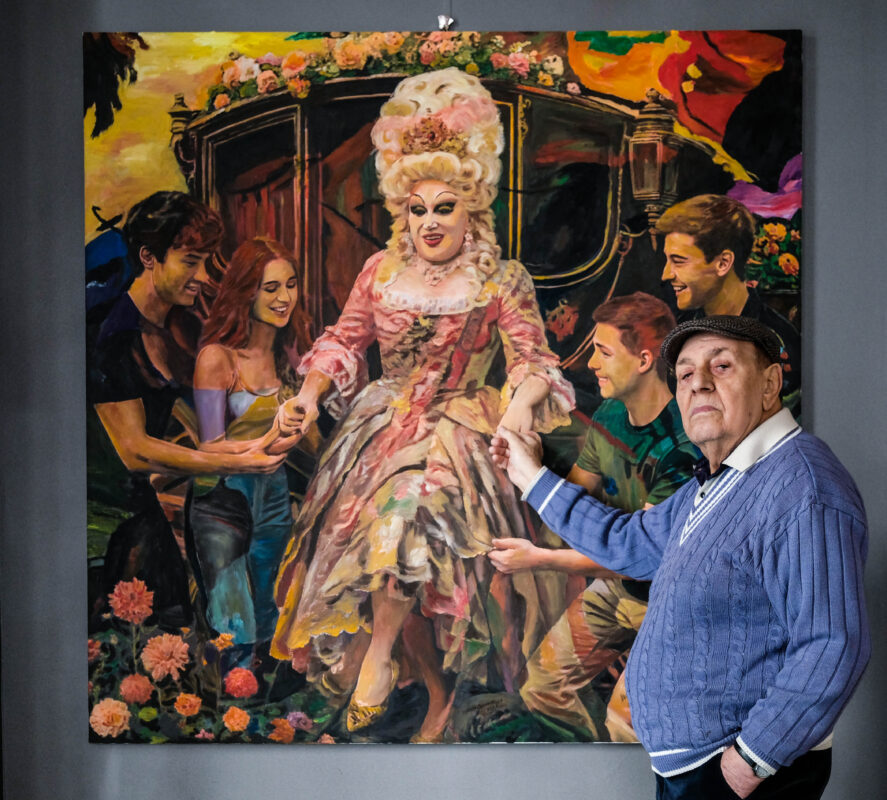
Assisted descent” configures itself as a pictorial field to be crossed, rather than as a simple scene. The apparent theatricality of the image, a figure in eighteenth-century clothes, almost a diva out of time, supported by four contemporary youths, is not to be read as citation or irony, but as a field of tension in which times, bodies and cultural codes interpenetrate to the point of losing stability.

The composition is centripetal: everything converges on the body of the central figure, who does not dominate but entrusts herself. The gesture of descent, indeed, is neither heroic nor tragic; it is a mediated, shared, almost negotiated act. The hands that support her are not handmaids of a power, but extensions of a relationship. Here the first shift is inserted: the scene does not represent a hierarchy, but a suspension of it. “Assistance” is not subordination, but rather a condition of possibility.

In this dynamic one glimpses the emergence of what, in the author, begins to configure itself as “restanza”. Not a declared theme, but a quality of experience: to remain within the passage, to inhabit the threshold without resolving it. The figure in historical costume, far from being a relic or a ghost, becomes an actual body precisely because held in a process of descent that never fully completes itself. It is in this delay, in this dilation of the gesture, that restanza takes form.

Painting itself supports this condition. The material treatment, dense and vibrant, avoids sharp definition and lets emerge a continuous oscillation between figure and background. The warm, almost feverish colours do not build a nostalgic atmosphere but an unstable emotional temperature, where the past is not reconstructed, but reactivated as a restless presence. Space too, between carriage, garden and open scene, never closes into a coherent perspective, but remains porous, traversable.

The four youths who assist the descent are not simple extras: they embody a minimal, provisional community, that constitutes itself around a shared gesture. There is no pre-existing collective identity; there is rather a becoming-together in the very act of supporting. In this sense, restanza declines itself also as a relational practice: one does not remain alone, but within a web of reciprocal dependencies.

“Assisted descent” thus marks a decisive passage in the author’s research: the abandonment of a thematic conception of the work in favour of an experiential dimension. Here meaning is not given, but happens. And it happens precisely at that unstable point where someone is about to descend, but continues, thanks to the others, to remain.

And she remains, suspended between presence and waiting, ready to find a gaze that welcomes her: the work is available for those who wish to keep its time and its breath.

“Veglia morbida”

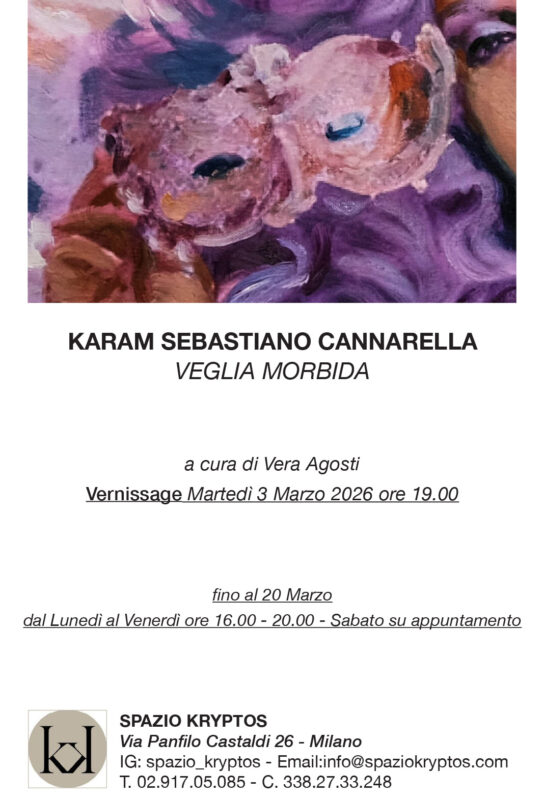
“Veglia morbida”, solo exhibition by Karam Sebastiano Cannarella at Spazio Kryptos in Milan, curated by Vera Agosti, from 4 to 20 March 2026. Some twenty previously unseen works that stage – though it would be more correct to say: dismantle – the figure of the performative body, of the body that disguises itself, of the […]