Author Archives: Karam

There are days when, standing before the canvas, I am not looking for a subject. I am looking for light.

Not the kind that illuminates everything and makes everything clear. I am interested in a different kind of light: the kind that streams in through a door left ajar, passes through an empty room, glances off a weathered wall, and settles on an object that someone left there a long time ago.

It is a light that does not explain.
It simply remains.

Perhaps this is precisely where an image is born.

Before colour, before form, even before the brushstroke, there is something that surfaces from memory. It is never a precise memory. It is rather a sensation: a room I have walked through, a courtyard, the sea seen from a window, a curtain stirred by the wind, a table left set, a door that has not quite closed.

When I paint, I do not try to reconstruct that place. If I did, it would become a narrative, a description. Instead, I seek what that place has retained.

And this is where light meets ‘Restanza’.

To remain does not mean to be motionless. It means to continue to exist in the traces, in the transformations, in the things that survive the passage of time.

Light does exactly this.

It passes through what changes and, for an instant, makes visible what remains.

On a wall, it reveals a wound.
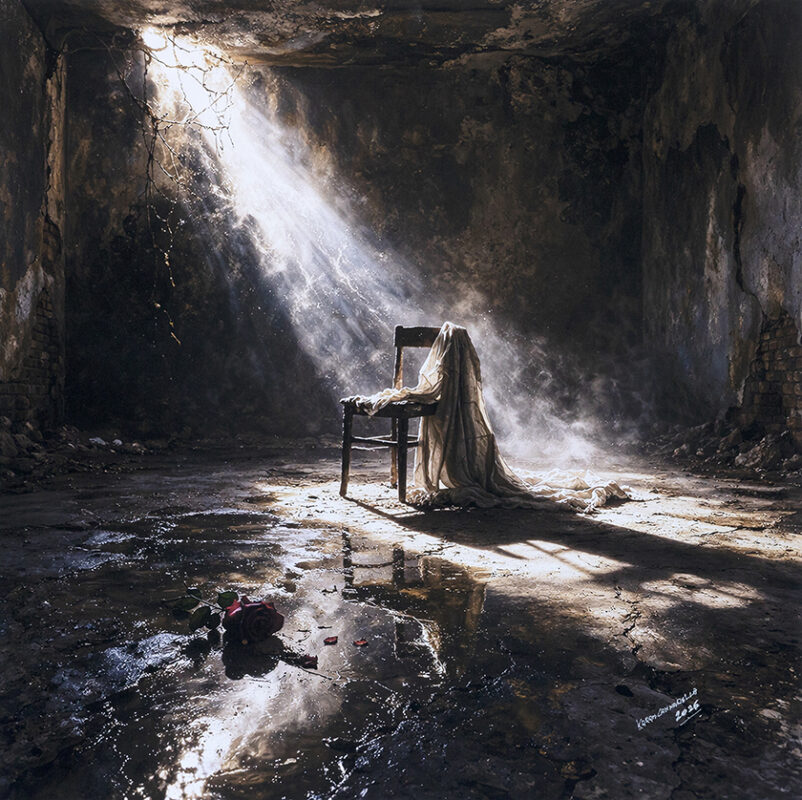
On an empty chair, it makes one sense the body that once sat there.
On a closed door, it preserves the idea of a passage.
Inside an abandoned room, it does not erase the absence: it gives it form.

For this reason, in my painting, light and ‘Restanza’ are part of the same gesture.

‘Restanza’ is not merely that which endures. It is that which continues to manifest itself after something has changed, departed or disappeared. And light is the means through which that residual presence re-emerges.

When I work on the canvas, I spread it out, erase it, cover it. Sometimes I make it almost disappear beneath darker layers. Then I go back to look for it.

This, too, is ultimately ‘Restanza’.

Something is covered up, but it is not lost. It remains beneath the surface. It waits. And when it resurfaces, it is no longer what it was before: it carries with it all the layers it has passed through.

It is then that light ceases to be merely an effect.

It becomes matter.

It becomes memory.

It becomes painting.

Perhaps this is why, in my paintings, darkness is never completely dark and light is never merely light. Between the two lies a threshold.

It is within that threshold that I work.

I do not want to illuminate everything. Some things must remain in the shadows, because even the shadows hold things safe. Light must reach only where it is needed, just as when, upon entering an old house, we recognise something without immediately knowing what it is we have recognised.

In the end, the work often consists of taking away.

Taking away the superfluous.
Taking away what reveals too much.
Taking away what prevents silence from entering.

Until only a few things remain: a surface, a wound, a shadow, perhaps an object.

And a light that continues to be there.

For me, that light is the simplest form of ‘Restanza’:

something has passed, but not everything has gone.

And it is precisely from what remains that an image can emerge.

Karam Sebastiano Cannarella

How an image is born

The birth of Restanza. From the figure to absence

Images are not born in front of a canvas. They are born much earlier.

Sometimes a door left ajar, an empty room, an object left in its place, a light that enters in silence is enough. In that instant I feel that the place continues to hold something, even though the people are no longer there.

For many years I painted the human figure. Then I understood that, in certain cases, absence tells more than presence. This is how my path dedicated to Restanza was born.

Restanza is not nostalgia. It is not the desire to go back. It is what remains when time has passed: a memory that continues to inhabit spaces, a trace that endures without making a sound.

Each of my works is born from an image that surprises me. I do not seek it: I recognise it. It is as if it had always been there, waiting to be truly looked at.

This is why I believe that the artist’s task is not to invent images, but to learn to see them. Only then can they be transformed into painting.

This project of mine is born precisely with this intent: to share the path that carries an image from memory to the canvas, showing how a place, a light or a small detail can become a work of art

The places that remember: the invisible presence and the light of absence

There are places that seem empty, but are not. An abandoned house, a room that has stayed closed, a courtyard worn by time can keep holding the presence of those who inhabited them.

You do not need to see a figure to sense its passage. Sometimes a half-open door, a motionless curtain, a table on which an object has been left are enough. They are minimal traces, but they can tell an entire life.

When I return to the places of my childhood, in Portopalo di Capo Passero, I do not see only what exists today. I see again what was there before. The simple houses, the streets, the sea, the boats and the men who set out while it was still dark. The present continually mingles with memory.

Even when people are no longer here, something of them remains. It remains in the walls, in the objects used every day, in the arrangement of a room. Above all, it remains in the light.

The light that comes through a window does not only illuminate a space. It can reveal a lack. It shows the point where someone sat, worked or waited. This is why, in my paintings, light does not erase absence: it makes it visible.

A place preserves memory without the need for words. It does not recount precisely what happened, but it holds a sensation. Whoever enters can perceive a presence, even without knowing the story of that house or of the people who lived there.

In painting I seek exactly this: not the exact reconstruction of the past, but what the past has left behind.

For a long time I painted the body and the figure. Then, slowly, I felt the need to look at what remained after their passage. The figure disappeared, but the space kept speaking of it. From this awareness my work on Restanza was born.

Restanza is not only what remains materially. It is a presence that resists time. It is the mark left by a person, by a gesture or by a waiting. Something we can no longer touch, but which keeps living within us and in the places we have crossed.

A ruined wall can hold more memory than a photograph. A crack can become a threshold. An abandoned bed can speak of an absent body. An old object can recall the hands that used it.

There is no need to add many elements. Often a light, a shadow and a trace are enough. The rest must remain in silence, so that those who look may also enter the work with their own memory.

Each of us owns a place that we keep carrying within. It may be the house of childhood, a parents’ room, a street, a beach or a garden. Returning there, we realise that time has changed everything. And yet, in a corner, in a scent or in a reflection, we suddenly find again what we thought was lost.

Perhaps places remember differently from us. They do not keep the facts, but the traces. They do not hold the voices, but their silence. They cannot give us back the people, but they keep showing us the emptiness they have left.

To learn to look at a place, then, means not to stop at what appears. It means recognising what keeps living behind a door, upon a wall or within a light.

Because a place is never only a space.

It is what happened there. It is who inhabited it. It is the time that passed through it, leaving a mark.

And it is, above all, what remains when everything seems to have gone away.

What remains when everything else is gone

There are objects that seem to have nothing left to say.
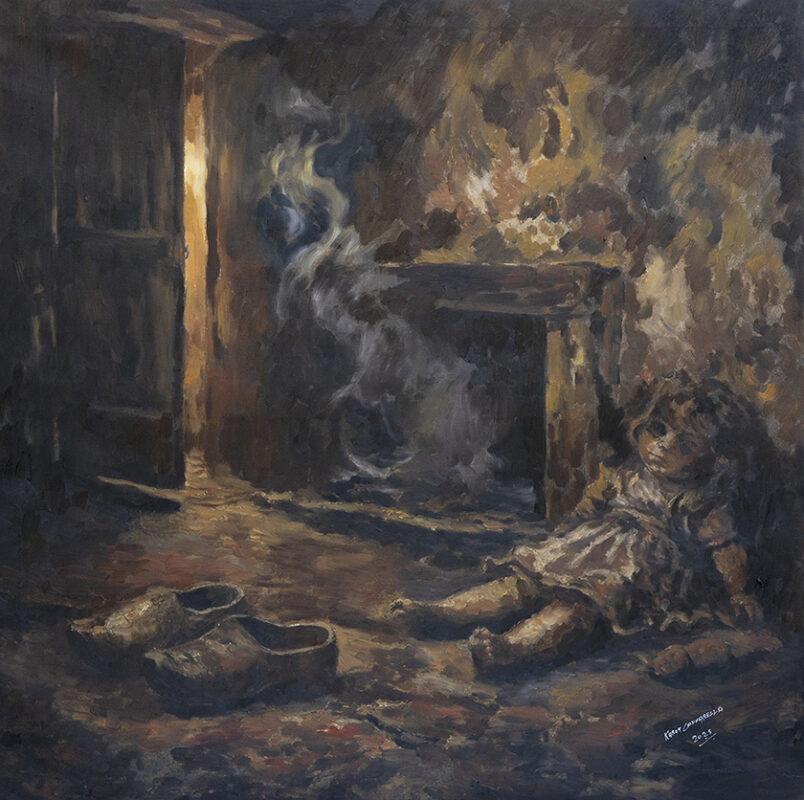
An empty chair, a half-open door, an old mirror, an abandoned bed, a forgotten toy. Ordinary objects, which we meet every day without truly looking at them.
And yet, when someone goes away, those same objects change.
They become witnesses.
An empty chair is no longer just a chair. It speaks to us of whoever used to sit there. A door left open keeps the idea of someone who passed through it. An unmade bed can tell of a presence more intensely than a face.

This is what interests me in my painting of recent years: not to represent what is there, but to seek what remains.
For a long time I painted the human figure. The body, the face, the gesture were at the centre of the picture. Then, slowly, I began to feel that I could tell of the human being even without showing him.
Perhaps even with greater intensity.

This is how Restanza was born.
Walls, doors, empty rooms, curtains, mirrors, objects left behind appeared in my paintings. They are not still lifes and they do not want to be merely abandoned places. They are spaces in which something has happened.
The object then becomes a trace.

Let us think of the houses in which we have lived. It is enough to return to them after many years for an apparently insignificant detail to bring a whole world back to the surface: a window, a table, a floor tile, even the way the light enters a room.
The object possesses no memory, of course. It is we who hand it over to it.

And it is right here that the painter’s work begins.
I paint an object not to describe it, but to question what it carries with it. I remove what is superfluous, I let silence occupy part of the picture, and I look for a light capable of bringing out something that cannot be seen.

Because painting, at least for me, must not explain everything.
It must leave a question.
Who opened that door?
Who slept in that bed?
Why did that chair remain empty?
What happened in that room?

When a picture manages to make us ask these questions, the object has stopped being a thing.
It has become a story.
And perhaps learning to look means exactly this: realising that even what seems still and silent can hold a presence.

Sometimes it is enough to stop in front of something we have seen a thousand times.
And to look at it as if for the first time.

From memory to painting

There are memories that belong to the past and others that keep living inside us. For me, painting is born above all from the latter.

I have crossed very different places, cities and seasons, but some images have never left me: the sea of Portopalo, the Island of Capo Passero, houses marked by time, a door left ajar, an empty room, the light coming through a window. They are simple images, and yet they have continued to accompany me even when I was far away.
For many years I painted the figure, the body, presence. Over time, however, I understood that even what we do not see can have a very strong presence. Sometimes an empty place tells more than a figure. An abandoned object, a worn wall, a moving curtain can preserve the memory of those who passed through.

From this awareness Restanza was born.
Restanza is not nostalgia. It does not mean going back. It is rather questioning what remains when a presence disappears, when a gesture is over, when time seems to have taken everything away.
Something always remains.
A trace remains, a light, a wound in the wall, a forgotten object. Above all memory remains, which transforms what we have lived and keeps giving it back to us in new forms.
When I paint I therefore do not try to faithfully reconstruct a memory. I do not want to tell it like a photograph. I let it surface, lose its outlines, meet the present. It is then that the memory stops being only mine and can become painting.
Light too, in my most recent works, has taken on a different meaning. It does not simply serve to illuminate things. It crosses time, reveals what seemed to have vanished and makes a presence visible precisely through its absence.

Perhaps all my recent painting is born from this question: what remains of us in the places we have crossed?
I do not know a definitive answer.

When a place preserves memory

There are places that do not forget.
Even when people go away, when a door is closed, when a house stays empty or a craft disappears, something keeps inhabiting those spaces. It is not a presence we can see with our eyes. It is a trace.

I have always thought that places possess a memory different from ours. We remember through images, faces, words. Places remember through signs: a worn wall, a window left ajar, a moved chair, the light that always enters from the same side.

In Portopalo, where I was born, this feeling is particularly strong. The sea changes continuously and yet it seems to keep everything. The departures, the waiting, the work of men, the boats that came back, the voices that once filled the shore. Many of those voices are no longer here today, but when I look at certain places I have the feeling that they have not truly disappeared.

Perhaps this is exactly what I look for in painting.

I am not only interested in representing what I see. I seek what remains after something has happened.

An empty place, for example, is not necessarily a place without life. Sometimes it is exactly the opposite. Absence can become a very strong presence. An empty room can tell of whoever lived in it. A table can keep the memory of whoever sat at it. A door can speak of someone who passed through it.

But one must stop.
We live in a time that accustoms us to looking quickly. We see thousands of images, but often we keep none of them. We pass in front of things without granting them the time to speak to us.

Learning to look also means learning to stay.
To stay in front of an image, in front of a landscape, in front of a wall marked by time. To wait for what at first seems insignificant to begin to reveal itself.

Memory does not need great monuments. Sometimes it hides in the simplest things.
A crack.
A curtain that moves.
A forgotten object.
A blade of light on the floor.
They are small signs, but they can contain an entire life.

In my painting of recent years these signs have become more and more important. The human figure may even disappear, but what its passage has left behind remains. It is from this idea that Restanza is born for me: not what simply remains, but what continues to exist because it has crossed time and still carries its trace.

Light too preserves memory.
When it enters an abandoned room it does not only illuminate things. It questions them. It brings out a surface, a wound in the wall, an almost erased colour. For an instant what seemed lost becomes present again.

Perhaps painting also serves this purpose: not to stop time, but to make visible what time has not managed to erase.
Because some places, even when they seem empty, keep on holding something of us.
One only has to learn to look at them

Why some places are never forgotten

There are memories that belong to the past and others that keep living inside us. For me, painting is born above all from the latter.

I have crossed very different places, cities and seasons, but some images have never left me: the sea of Portopalo, the Island of Capo Passero, houses marked by time, a door left ajar, an empty room, the light coming through a window. They are simple images, and yet they have continued to accompany me even when I was far away.
For many years I painted the figure, the body, presence. Over time, however, I understood that even what we do not see can have a very strong presence. Sometimes an empty place tells more than a figure. An abandoned object, a worn wall, a moving curtain can preserve the memory of those who passed through.

From this awareness Restanza was born.
Restanza is not nostalgia. It does not mean going back. It is rather questioning what remains when a presence disappears, when a gesture is over, when time seems to have taken everything away.
Something always remains.
A trace remains, a light, a wound in the wall, a forgotten object. Above all memory remains, which transforms what we have lived and keeps giving it back to us in new forms.
When I paint I therefore do not try to faithfully reconstruct a memory. I do not want to tell it like a photograph. I let it surface, lose its outlines, meet the present. It is then that the memory stops being only mine and can become painting.
Light too, in my most recent works, has taken on a different meaning. It does not simply serve to illuminate things. It crosses time, reveals what seemed to have vanished and makes a presence visible precisely through its absence.

Perhaps all my recent painting is born from this question: what remains of us in the places we have crossed?
I do not know a definitive answer.