


There are objects that seem to have nothing left to say.
An empty chair, a half-open door, an old mirror, an abandoned bed, a forgotten toy. Ordinary objects, which we meet every day without truly looking at them.
And yet, when someone goes away, those same objects change.
They become witnesses.
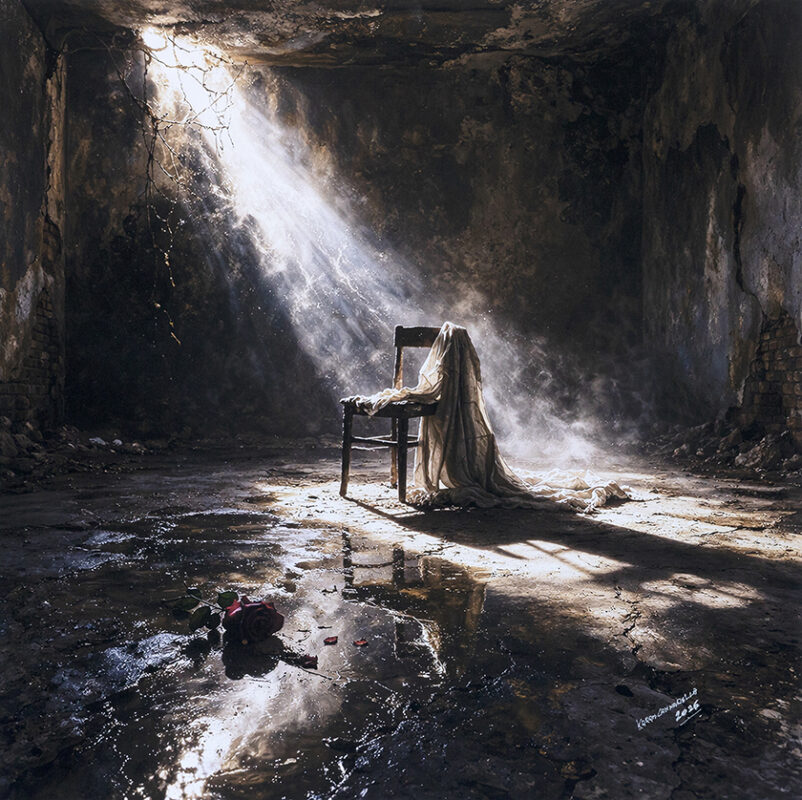
An empty chair is no longer just a chair. It speaks to us of whoever used to sit there. A door left open keeps the idea of someone who passed through it. An unmade bed can tell of a presence more intensely than a face.
This is what interests me in my painting of recent years: not to represent what is there, but to seek what remains.
For a long time I painted the human figure. The body, the face, the gesture were at the centre of the picture. Then, slowly, I began to feel that I could tell of the human being even without showing him.
Perhaps even with greater intensity.
This is how Restanza was born.
Walls, doors, empty rooms, curtains, mirrors, objects left behind appeared in my paintings. They are not still lifes and they do not want to be merely abandoned places. They are spaces in which something has happened.
The object then becomes a trace.
Let us think of the houses in which we have lived. It is enough to return to them after many years for an apparently insignificant detail to bring a whole world back to the surface: a window, a table, a floor tile, even the way the light enters a room.
The object possesses no memory, of course. It is we who hand it over to it.
And it is right here that the painter’s work begins.
I paint an object not to describe it, but to question what it carries with it. I remove what is superfluous, I let silence occupy part of the picture, and I look for a light capable of bringing out something that cannot be seen.
Because painting, at least for me, must not explain everything.
It must leave a question.
Who opened that door?
Who slept in that bed?
Why did that chair remain empty?
What happened in that room?
When a picture manages to make us ask these questions, the object has stopped being a thing.
It has become a story.
And perhaps learning to look means exactly this: realising that even what seems still and silent can hold a presence.
Sometimes it is enough to stop in front of something we have seen a thousand times.
And to look at it as if for the first time.
Karam Sebastiano Cannarella