



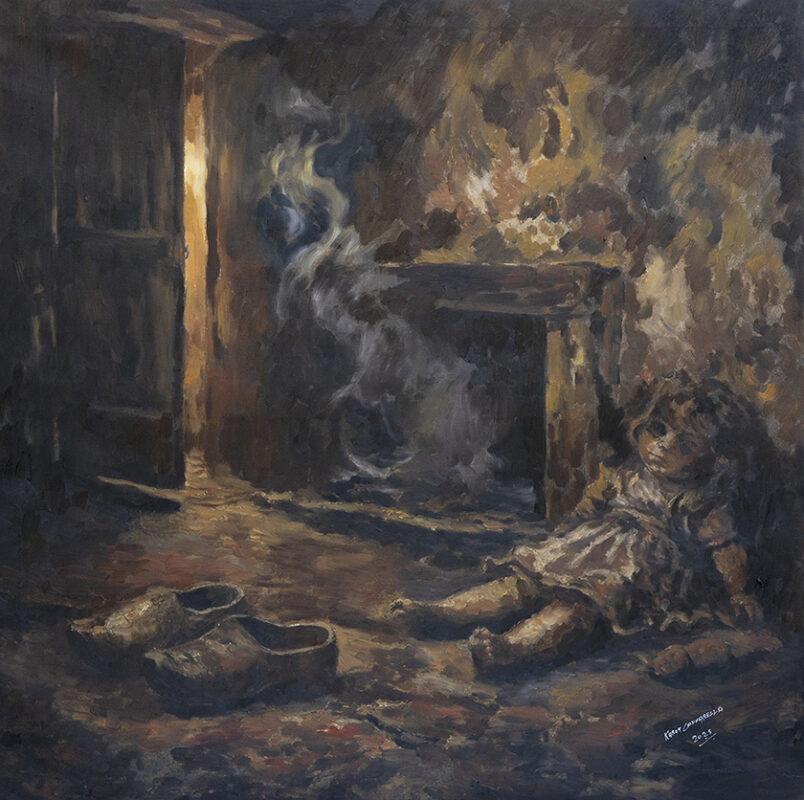
There are places that do not forget.
Even when people go away, when a door is closed, when a house stays empty or a craft disappears, something keeps inhabiting those spaces. It is not a presence we can see with our eyes. It is a trace.
I have always thought that places possess a memory different from ours. We remember through images, faces, words. Places remember through signs: a worn wall, a window left ajar, a moved chair, the light that always enters from the same side.
In Portopalo, where I was born, this feeling is particularly strong. The sea changes continuously and yet it seems to keep everything. The departures, the waiting, the work of men, the boats that came back, the voices that once filled the shore. Many of those voices are no longer here today, but when I look at certain places I have the feeling that they have not truly disappeared.
Perhaps this is exactly what I look for in painting.
I am not only interested in representing what I see. I seek what remains after something has happened.
An empty place, for example, is not necessarily a place without life. Sometimes it is exactly the opposite. Absence can become a very strong presence. An empty room can tell of whoever lived in it. A table can keep the memory of whoever sat at it. A door can speak of someone who passed through it.
But one must stop.
We live in a time that accustoms us to looking quickly. We see thousands of images, but often we keep none of them. We pass in front of things without granting them the time to speak to us.
Learning to look also means learning to stay.
To stay in front of an image, in front of a landscape, in front of a wall marked by time. To wait for what at first seems insignificant to begin to reveal itself.
Memory does not need great monuments. Sometimes it hides in the simplest things.
A crack.
A curtain that moves.
A forgotten object.
A blade of light on the floor.
They are small signs, but they can contain an entire life.
In my painting of recent years these signs have become more and more important. The human figure may even disappear, but what its passage has left behind remains. It is from this idea that Restanza is born for me: not what simply remains, but what continues to exist because it has crossed time and still carries its trace.
Light too preserves memory.
When it enters an abandoned room it does not only illuminate things. It questions them. It brings out a surface, a wound in the wall, an almost erased colour. For an instant what seemed lost becomes present again.
Perhaps painting also serves this purpose: not to stop time, but to make visible what time has not managed to erase.
Because some places, even when they seem empty, keep on holding something of us.
One only has to learn to look at them.
Karam Sebastiano Cannarella