Category Archives: Blog

The places that remember: the invisible presence and the light of absence

There are places that seem empty, but are not. An abandoned house, a room that has stayed closed, a courtyard worn by time can keep holding the presence of those who inhabited them.

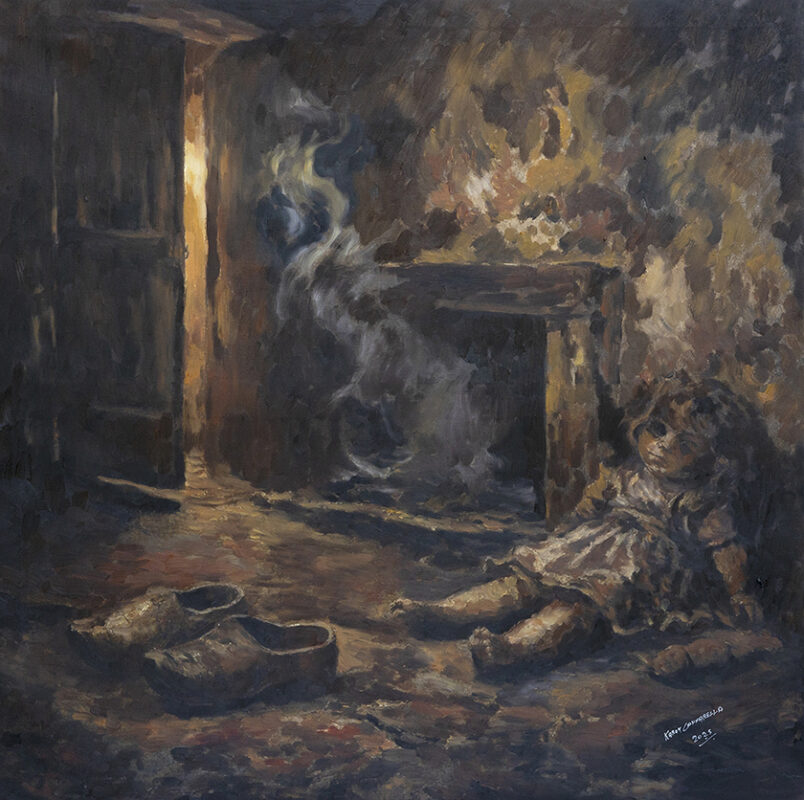
You do not need to see a figure to sense its passage. Sometimes a half-open door, a motionless curtain, a table on which an object has been left are enough. They are minimal traces, but they can tell an entire life.

When I return to the places of my childhood, in Portopalo di Capo Passero, I do not see only what exists today. I see again what was there before. The simple houses, the streets, the sea, the boats and the men who set out while it was still dark. The present continually mingles with memory.

Even when people are no longer here, something of them remains. It remains in the walls, in the objects used every day, in the arrangement of a room. Above all, it remains in the light.

The light that comes through a window does not only illuminate a space. It can reveal a lack. It shows the point where someone sat, worked or waited. This is why, in my paintings, light does not erase absence: it makes it visible.

A place preserves memory without the need for words. It does not recount precisely what happened, but it holds a sensation. Whoever enters can perceive a presence, even without knowing the story of that house or of the people who lived there.

In painting I seek exactly this: not the exact reconstruction of the past, but what the past has left behind.

For a long time I painted the body and the figure. Then, slowly, I felt the need to look at what remained after their passage. The figure disappeared, but the space kept speaking of it. From this awareness my work on Restanza was born.

Restanza is not only what remains materially. It is a presence that resists time. It is the mark left by a person, by a gesture or by a waiting. Something we can no longer touch, but which keeps living within us and in the places we have crossed.

A ruined wall can hold more memory than a photograph. A crack can become a threshold. An abandoned bed can speak of an absent body. An old object can recall the hands that used it.

There is no need to add many elements. Often a light, a shadow and a trace are enough. The rest must remain in silence, so that those who look may also enter the work with their own memory.

Each of us owns a place that we keep carrying within. It may be the house of childhood, a parents’ room, a street, a beach or a garden. Returning there, we realise that time has changed everything. And yet, in a corner, in a scent or in a reflection, we suddenly find again what we thought was lost.

Perhaps places remember differently from us. They do not keep the facts, but the traces. They do not hold the voices, but their silence. They cannot give us back the people, but they keep showing us the emptiness they have left.

To learn to look at a place, then, means not to stop at what appears. It means recognising what keeps living behind a door, upon a wall or within a light.

Because a place is never only a space.

It is what happened there. It is who inhabited it. It is the time that passed through it, leaving a mark.

And it is, above all, what remains when everything seems to have gone away.
From memory to painting

There are memories that belong to the past and others that keep living inside us. For me, painting is born above all from the latter.

I have crossed very different places, cities and seasons, but some images have never left me: the sea of Portopalo, the Island of Capo Passero, houses marked by time, a door left ajar, an empty room, the light coming through a window. They are simple images, and yet they have continued to accompany me even when I was far away.
For many years I painted the figure, the body, presence. Over time, however, I understood that even what we do not see can have a very strong presence. Sometimes an empty place tells more than a figure. An abandoned object, a worn wall, a moving curtain can preserve the memory of those who passed through.

From this awareness Restanza was born.
Restanza is not nostalgia. It does not mean going back. It is rather questioning what remains when a presence disappears, when a gesture is over, when time seems to have taken everything away.
Something always remains.
A trace remains, a light, a wound in the wall, a forgotten object. Above all memory remains, which transforms what we have lived and keeps giving it back to us in new forms.
When I paint I therefore do not try to faithfully reconstruct a memory. I do not want to tell it like a photograph. I let it surface, lose its outlines, meet the present. It is then that the memory stops being only mine and can become painting.
Light too, in my most recent works, has taken on a different meaning. It does not simply serve to illuminate things. It crosses time, reveals what seemed to have vanished and makes a presence visible precisely through its absence.

Perhaps all my recent painting is born from this question: what remains of us in the places we have crossed?
I do not know a definitive answer.

When a place preserves memory

There are places that do not forget.
Even when people go away, when a door is closed, when a house stays empty or a craft disappears, something keeps inhabiting those spaces. It is not a presence we can see with our eyes. It is a trace.

I have always thought that places possess a memory different from ours. We remember through images, faces, words. Places remember through signs: a worn wall, a window left ajar, a moved chair, the light that always enters from the same side.

In Portopalo, where I was born, this feeling is particularly strong. The sea changes continuously and yet it seems to keep everything. The departures, the waiting, the work of men, the boats that came back, the voices that once filled the shore. Many of those voices are no longer here today, but when I look at certain places I have the feeling that they have not truly disappeared.

Perhaps this is exactly what I look for in painting.

I am not only interested in representing what I see. I seek what remains after something has happened.

An empty place, for example, is not necessarily a place without life. Sometimes it is exactly the opposite. Absence can become a very strong presence. An empty room can tell of whoever lived in it. A table can keep the memory of whoever sat at it. A door can speak of someone who passed through it.

But one must stop.
We live in a time that accustoms us to looking quickly. We see thousands of images, but often we keep none of them. We pass in front of things without granting them the time to speak to us.

Learning to look also means learning to stay.
To stay in front of an image, in front of a landscape, in front of a wall marked by time. To wait for what at first seems insignificant to begin to reveal itself.

Memory does not need great monuments. Sometimes it hides in the simplest things.
A crack.
A curtain that moves.
A forgotten object.
A blade of light on the floor.
They are small signs, but they can contain an entire life.

In my painting of recent years these signs have become more and more important. The human figure may even disappear, but what its passage has left behind remains. It is from this idea that Restanza is born for me: not what simply remains, but what continues to exist because it has crossed time and still carries its trace.

Light too preserves memory.
When it enters an abandoned room it does not only illuminate things. It questions them. It brings out a surface, a wound in the wall, an almost erased colour. For an instant what seemed lost becomes present again.

Perhaps painting also serves this purpose: not to stop time, but to make visible what time has not managed to erase.
Because some places, even when they seem empty, keep on holding something of us.
One only has to learn to look at them

Why some places are never forgotten

There are memories that belong to the past and others that keep living inside us. For me, painting is born above all from the latter.

I have crossed very different places, cities and seasons, but some images have never left me: the sea of Portopalo, the Island of Capo Passero, houses marked by time, a door left ajar, an empty room, the light coming through a window. They are simple images, and yet they have continued to accompany me even when I was far away.
For many years I painted the figure, the body, presence. Over time, however, I understood that even what we do not see can have a very strong presence. Sometimes an empty place tells more than a figure. An abandoned object, a worn wall, a moving curtain can preserve the memory of those who passed through.

From this awareness Restanza was born.
Restanza is not nostalgia. It does not mean going back. It is rather questioning what remains when a presence disappears, when a gesture is over, when time seems to have taken everything away.
Something always remains.
A trace remains, a light, a wound in the wall, a forgotten object. Above all memory remains, which transforms what we have lived and keeps giving it back to us in new forms.
When I paint I therefore do not try to faithfully reconstruct a memory. I do not want to tell it like a photograph. I let it surface, lose its outlines, meet the present. It is then that the memory stops being only mine and can become painting.
Light too, in my most recent works, has taken on a different meaning. It does not simply serve to illuminate things. It crosses time, reveals what seemed to have vanished and makes a presence visible precisely through its absence.

Perhaps all my recent painting is born from this question: what remains of us in the places we have crossed?
I do not know a definitive answer.

The light that crosses time

There are lights that illuminate and lights that remember.

In my painting light is never merely a natural fact. It does not simply serve to make a figure, a wall, the sea or a door visible. It is something that comes from farther away. It crosses time, meets what has remained and, for an instant, gives it back a presence.

I have always thought that time does not truly erase things. It transforms them. It leaves traces, wears out colours, empties rooms, takes people away. But something remains.

It is precisely in that little that remains that I seek my painting.

When I paint an empty place, I do not think it is truly empty. Someone passed through there. Someone opened that door, looked at that sea, laid a hand on that wall. Perhaps we will never know who they were, but their absence continues to inhabit the space.

Light then enters like a memory.

It does not tell everything. It does not explain. It grazes.

It can be a clear blade crossing a room, a glimmer on the sea, a suddenly luminous area within a darker sky. I am interested above all when it seems to arrive from a place we do not see.

It is a light that does not belong only to the present.

Perhaps for this reason, in recent years, the human figure has progressively given way in my paintings. For a long time I painted the body, the face, the gesture. Today I am also interested in what comes after: what remains when the body is no longer there.

From this research Restanza was born.

To remain, for me, does not mean to be motionless. It means to continue to exist in another form. A door left ajar, a forgotten object, a marked wall, a sea horizon can contain more memory than a directly represented figure.

Light makes this permanence visible.

In Portopalo, where I was born, I learned very early to look at it. The light on the sea is never the same. It changes continuously and at the same time seems very ancient. It is the same light the fishermen saw, those who departed and those who waited on the shore. It passed over the boats, the tuna fisheries, the houses and the people who are no longer here today.

When I return before that sea, I feel that present and past can stand in the same instant.

Perhaps this is what I seek when I paint.

I do not want to reconstruct what has been. I do not want to tell the past like a photograph. I seek rather the point where the past continues silently to live in the present.

And light is the passage.

It crosses the years without belonging to anyone. It touches what is born and what disappears. It reveals something for a moment and immediately after lets it return into silence.

Even when I address the sacred, it is this light that I seek. Not a spectacular or decorative light, but a restrained presence. Something that suggests without declaring, that leaves the viewer the space to feel.

Because I believe that painting must not always give answers.

Sometimes it must only open a threshold.

Before a painting I would like the one who looks to be able to stop and have the sensation that something has just happened, or that it is about to happen. We do not know what. We see only a trace, a shadow, a light.

The rest belongs to our memory.

At eighty-four the meaning of time inevitably becomes different. I do not consider it only as something that passes. I see it as a matter that deposits itself within us. Every encounter, every journey, every person known, every place left continues in some way to accompany us.

Painting allows me to bring all this back to the surface without having to tell it directly.

A colour, an emptiness, a threshold can contain many years.

And then the light arrives.

It crosses the painting as it crosses life: for a moment it makes visible what we believed lost.

Perhaps this is the reason why I keep painting.

To seek, within what remains, that small light capable of crossing time.

When a place knows memory

There are places that are not only spaces. They are presences. They hold time without retaining it, like a stone that keeps preserving the warmth of the sun even after sunset.

Entering certain settings one has the sensation that someone has just left. It is not the people who remain, but their passing. A chair slightly moved, a door left ajar, a wall worn by the light, a drape that stirs faintly. They are minimal traces, yet capable of telling more than any figure.

Memory does not dwell only in human beings. It lives in places too.

Every house, every church, every harbour, every room crossed by life preserves something that cannot be measured. It is a silence that speaks. It is time that settles slowly upon things.

Perhaps it is precisely here that my painting is born.

I do not paint nostalgia. I seek permanence. I seek what remains when the noise moves away. Every painting is the attempt to make an invisible presence visible, to show that absence is never an absolute void.

Light then becomes the true face of memory. It does not only illuminate objects: it gives them back a story.

This is Restanza: not stopping for fear of leaving, but recognising the value of what continues to live in the places we have loved.

When a place knows memory, it is no longer only a place. It becomes a testimony. And art, perhaps, does nothing but listen to that testimony and transform it into light.

Waiting for light

With Waiting for light, Karam Sebastiano Cannarella introduces into the Restanza cycle a reflection on the time of waiting, understood not as passive suspension, but as a form of permanence. The work renounces every narrative definition and builds a space in which painting becomes a sensory experience of flowing. There are no precise coordinates, nor a horizon capable of orienting the gaze. Everything seems to belong to a single liquid matter, crossed by a presence that emerges without ever imposing itself.

At the centre of the composition, a dark form surfaces from the water like a body suspended between immersion and emergence. It is not important to establish its identity. Cannarella does not seek the recognition of the image, but the condition it embodies. That figure is neither sinking nor resurfacing: it inhabits a fragile balance, entrusting itself to the very movement of the water. It is a presence that resists not by opposing the current, but by letting itself be crossed by it.
The title suggests the direction of the reading. The waiting does not concern the arrival of light as an external event. It is rather the inner disposition of one who keeps recognising its possibility even when everything seems immersed in uncertainty. Light, indeed, does not burst into the scene. It spreads slowly through the pictorial matter, transforming the deep blues into a vibrant surface, where every tone seems to hold a promise of brightness.

Within the poetics of Restanza, this work introduces a dimension of trust. To remain also means to accept the time necessary for something to manifest itself again. Permanence does not coincide with the wait for a solution, but with the capacity to inhabit the unfinished without losing the sense of direction. It is a silent choice, which renounces urgency in order to recognise value in the time of maturation.

Painting accompanies this vision through an essential construction, where the gesture becomes more gathered and the matter seems to breathe together with the water. The glazes, the transparencies and the sudden chromatic densities dissolve every boundary between figure and environment, letting colour itself generate the movement.

In this sense, Waiting for light does not narrate a landing, but the moment that makes it possible. Light is not yet fully present, and precisely for this reason it continues to exert its force. Cannarella suggests that restanza is not born from the certainty of what will come, but from the capacity to guard a hope even when its horizon remains invisible. It is in this discreet tension, made of trust and abandonment, that the work finds its most authentic intensity.

The time of images

We live in a time in which images are born and disappear with the same speed with which we scroll a screen. We see thousands of them, but few truly manage to inhabit our memory. Perhaps because we do not grant them the time necessary to enter within us.

I believe instead that every true work of art has its own time. Not the time of the clock, but that of waiting, of silence and of encounter. An authentic image does not impose itself: it waits. It stays there, discreet, until we are ready to welcome it.

When I paint I do not seek the immediate effect. I seek a presence that continues to live even when the painting has been left. It is in that moment that the deepest dialogue between the work and the one who observes it is born.

Painting is not only what is seen. It is what remains after having looked. It is a trace that keeps working within us, often without our noticing.

This is why I speak of Restanza. To remain does not mean to stop, but to guard what deserves not to be forgotten. Every image should have the courage to slow down time, to withdraw us for an instant from daily haste and to hand us back to silence.

Perhaps the task of art today is not to produce more images, but to give time back to images. Time to be looked at, understood and loved. Because only what finds the time to inhabit our heart can be transformed into memory.

The strength that remains

With The strength that remains, Karam Sebastiano Cannarella addresses one of the deepest cores of the Restanza cycle: the idea that strength is never synonymous with domination, but with generative capacity. The work renounces every recognisable reference and entrusts entirely to painting the task of making visible an energy that precedes form, as if matter were captured in the instant in which the world begins to surface.

There is no landscape to contemplate, nor an image to decipher. The surface is crossed by a continuous movement, in which water and light cease to be natural elements to become states of matter. The chromatic masses expand, compress, chase one another without ever fixing themselves definitively, generating a composition that seems to be born before the viewer’s eyes. Painting does not describe movement: it is movement.

The title suggests a strength that does not impose itself, but persists. It belongs neither to the violence of the wave nor to the stability of the rock. It is rather an invisible quality that crosses every transformation without being exhausted. In this sense, Cannarella moves away from a heroic conception of resistance to propose a subtler idea: authentic strength is that which keeps regenerating itself, adapting to change without losing its intensity.

Within Restanza, this work introduces a reflection on the vital character of becoming. To remain does not mean to preserve a form, but to guard the energy that makes every new form possible. It is a dynamic permanence, which does not oppose time but crosses it, recognising in change its own natural condition.
The pictorial matter accompanies this vision with a gestural freedom that reaches one of the most intense outcomes of the entire cycle. The deep blues, the sudden whites and the shadow zones do not build contrasts, but breathe together, giving rise to a surface in continuous expansion. Light does not intervene as an external element: it is born from the very dialogue between the colours, like a presence generated from within the painting.

The strength that remains does not narrate what survives after a loss. It narrates what continues to be born. It is an image in which restanza does not coincide with memory, but with the inexhaustible possibility of transformation. And it is perhaps precisely here that Cannarella’s research reaches one of its freest expressions: in recognising that permanence is not immobility, but the continuous resurfacing of life through matter.

Art begins when the gaze ends

We live in a time in which everyone sees, but few truly observe.
Images flow before our eyes at a speed that prevents us from stopping. And yet art is born exactly in the opposite moment: when the gaze slows down.
An artist does not simply add an image to the world. He seeks what the world holds in silence. A wall worn by time, a window open onto the sea, a chair left empty can tell far more than a crowded scene.
For years my research has moved in this direction. I am not interested in describing what happens, but what remains after everything has happened. It is in that silent space that I recognise the presence of time.
I have called this research Restanza. It is not nostalgia, nor memory. It is the capacity to recognise that every place preserves an invisible trace of those who inhabited it, of those who loved it, of those who left it.
Perhaps the task of art today is not to astonish, but to give depth back to our gaze. To teach us to pause. To recognise that even silence can have a voice and that light, when it meets time, becomes memory.