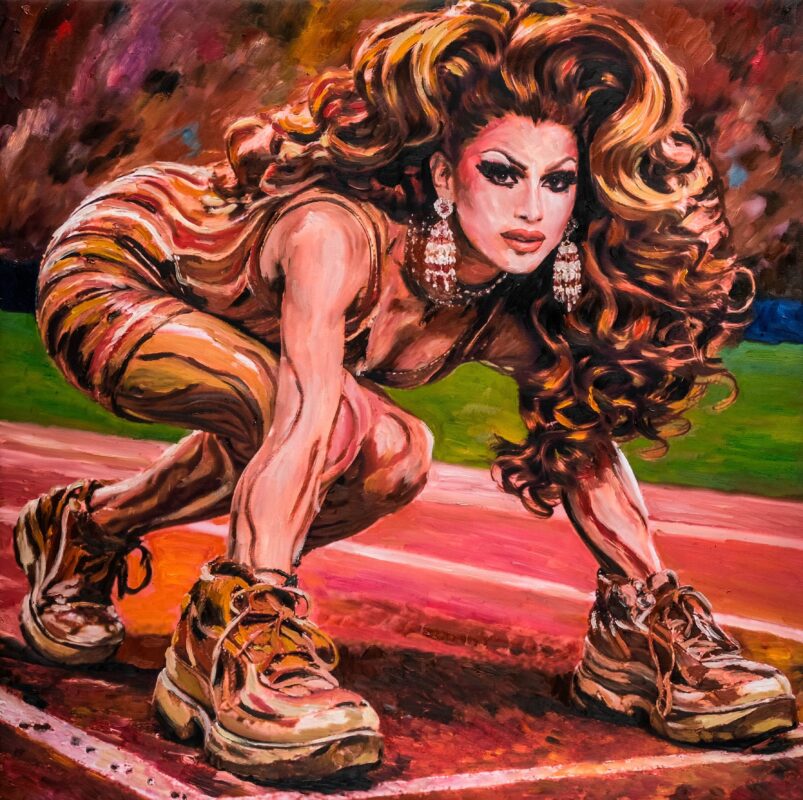
Threshold line concentrates all its energy in an instant of compression, in that moment which precedes the start but which, instead of exploding into movement, seems to hold itself back within the body. The figure crouched on the track does not simply occupy a performative space: it strains it. Every element of the image participates in this tension, from the hands resting on the ground to the twist of the legs, up to the almost excessive mass of hair that expands like an emotional extension of the gesture.
The work operates on the boundary between exposure and resistance. The posture recalls the iconography of the athletic start, but here competition loses centrality. There is no visible finish line, nor sporting dynamic. The threshold evoked by the title becomes rather an existential condition: an unstable point at which the subject is called to transform without knowing to what extent it will really be able to.
In this painting the author’s research further deepens the concept of restanza, which definitively ceases to belong to the order of theme to become embodied experience. To remain does not coincide with immobility, but with permanence within a tension that does not resolve. The figure seems ready for movement and at the same time incapable of separating from the point where it finds itself. It is precisely this contradiction that generates force.
The visual language too proceeds by accumulation and friction. Painting does not seek formal balance, but insists on the deformation of the gesture and the vibration of the surface. The lines of the track cross the picture like provisional coordinates, incapable of truly organising the space. The body, instead, emerges through continuous chromatic variations that make it unstable, almost crossed by contrasting energies.
The performative identity of the figure is not treated as a mask to be unmasked, but as an authentic place of exposure. There is no ironic distance, nor theatrical complacency. The face looks frontally, sustaining the gaze of the observer with a presence that does not ask for legitimation. In this frontality one senses an almost ritual dimension, as if the body were captured in the moment in which it attempts to redefine its own balance with respect to the world.
The thought that runs through the work too seems to move by fragments, deviations, sudden stops. Meaning is not delivered in a linear way but surfaces through successive thickenings, like something that takes form while continuously risking to disperse. Painting follows this same movement: it builds a presence and at the same time shows its precariousness.
Threshold line does not therefore tell of a completed passage, but of the permanence within its own friction. The threshold is not the point to be crossed: it is the place where the subject remains, exposes itself, continuously redefines itself. And it is precisely in this impossibility of stabilising that the work finds its most authentic intensity.
Paola Martino