



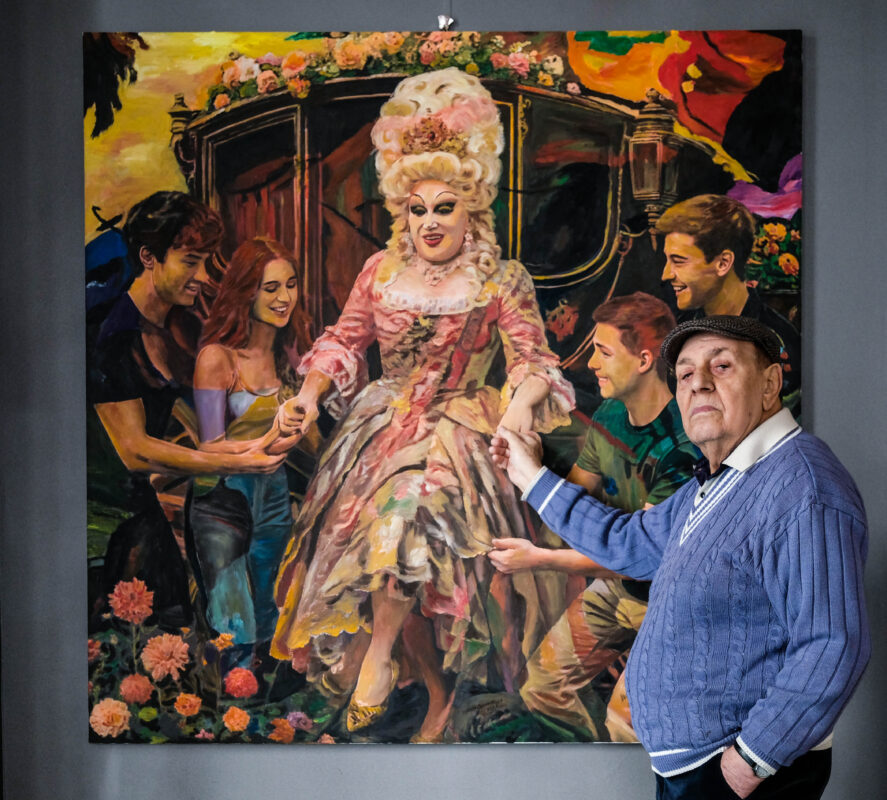
“Assisted descent” configures itself as a pictorial field to be crossed, rather than as a simple scene. The apparent theatricality of the image, a figure in eighteenth-century clothes, almost a diva out of time, supported by four contemporary youths, is not to be read as citation or irony, but as a field of tension in which times, bodies and cultural codes interpenetrate to the point of losing stability.
The composition is centripetal: everything converges on the body of the central figure, who does not dominate but entrusts herself. The gesture of descent, indeed, is neither heroic nor tragic; it is a mediated, shared, almost negotiated act. The hands that support her are not handmaids of a power, but extensions of a relationship. Here the first shift is inserted: the scene does not represent a hierarchy, but a suspension of it. “Assistance” is not subordination, but rather a condition of possibility.
In this dynamic one glimpses the emergence of what, in the author, begins to configure itself as “restanza”. Not a declared theme, but a quality of experience: to remain within the passage, to inhabit the threshold without resolving it. The figure in historical costume, far from being a relic or a ghost, becomes an actual body precisely because held in a process of descent that never fully completes itself. It is in this delay, in this dilation of the gesture, that restanza takes form.
Painting itself supports this condition. The material treatment, dense and vibrant, avoids sharp definition and lets emerge a continuous oscillation between figure and background. The warm, almost feverish colours do not build a nostalgic atmosphere but an unstable emotional temperature, where the past is not reconstructed, but reactivated as a restless presence. Space too, between carriage, garden and open scene, never closes into a coherent perspective, but remains porous, traversable.
The four youths who assist the descent are not simple extras: they embody a minimal, provisional community, that constitutes itself around a shared gesture. There is no pre-existing collective identity; there is rather a becoming-together in the very act of supporting. In this sense, restanza declines itself also as a relational practice: one does not remain alone, but within a web of reciprocal dependencies.
“Assisted descent” thus marks a decisive passage in the author’s research: the abandonment of a thematic conception of the work in favour of an experiential dimension. Here meaning is not given, but happens. And it happens precisely at that unstable point where someone is about to descend, but continues, thanks to the others, to remain.
And she remains, suspended between presence and waiting, ready to find a gaze that welcomes her: the work is available for those who wish to keep its time and its breath.
Paola Martino