Author Archives: Karam

The strength that remains

With The strength that remains, Karam Sebastiano Cannarella addresses one of the deepest cores of the Restanza cycle: the idea that strength is never synonymous with domination, but with generative capacity. The work renounces every recognisable reference and entrusts entirely to painting the task of making visible an energy that precedes form, as if matter were captured in the instant in which the world begins to surface.

There is no landscape to contemplate, nor an image to decipher. The surface is crossed by a continuous movement, in which water and light cease to be natural elements to become states of matter. The chromatic masses expand, compress, chase one another without ever fixing themselves definitively, generating a composition that seems to be born before the viewer’s eyes. Painting does not describe movement: it is movement.

The title suggests a strength that does not impose itself, but persists. It belongs neither to the violence of the wave nor to the stability of the rock. It is rather an invisible quality that crosses every transformation without being exhausted. In this sense, Cannarella moves away from a heroic conception of resistance to propose a subtler idea: authentic strength is that which keeps regenerating itself, adapting to change without losing its intensity.

Within Restanza, this work introduces a reflection on the vital character of becoming. To remain does not mean to preserve a form, but to guard the energy that makes every new form possible. It is a dynamic permanence, which does not oppose time but crosses it, recognising in change its own natural condition.
The pictorial matter accompanies this vision with a gestural freedom that reaches one of the most intense outcomes of the entire cycle. The deep blues, the sudden whites and the shadow zones do not build contrasts, but breathe together, giving rise to a surface in continuous expansion. Light does not intervene as an external element: it is born from the very dialogue between the colours, like a presence generated from within the painting.

The strength that remains does not narrate what survives after a loss. It narrates what continues to be born. It is an image in which restanza does not coincide with memory, but with the inexhaustible possibility of transformation. And it is perhaps precisely here that Cannarella’s research reaches one of its freest expressions: in recognising that permanence is not immobility, but the continuous resurfacing of life through matter.
Art begins when the gaze ends

We live in a time in which everyone sees, but few truly observe.
Images flow before our eyes at a speed that prevents us from stopping. And yet art is born exactly in the opposite moment: when the gaze slows down.
An artist does not simply add an image to the world. He seeks what the world holds in silence. A wall worn by time, a window open onto the sea, a chair left empty can tell far more than a crowded scene.
For years my research has moved in this direction. I am not interested in describing what happens, but what remains after everything has happened. It is in that silent space that I recognise the presence of time.
I have called this research Restanza. It is not nostalgia, nor memory. It is the capacity to recognise that every place preserves an invisible trace of those who inhabited it, of those who loved it, of those who left it.
Perhaps the task of art today is not to astonish, but to give depth back to our gaze. To teach us to pause. To recognise that even silence can have a voice and that light, when it meets time, becomes memory.

The wound that holds light

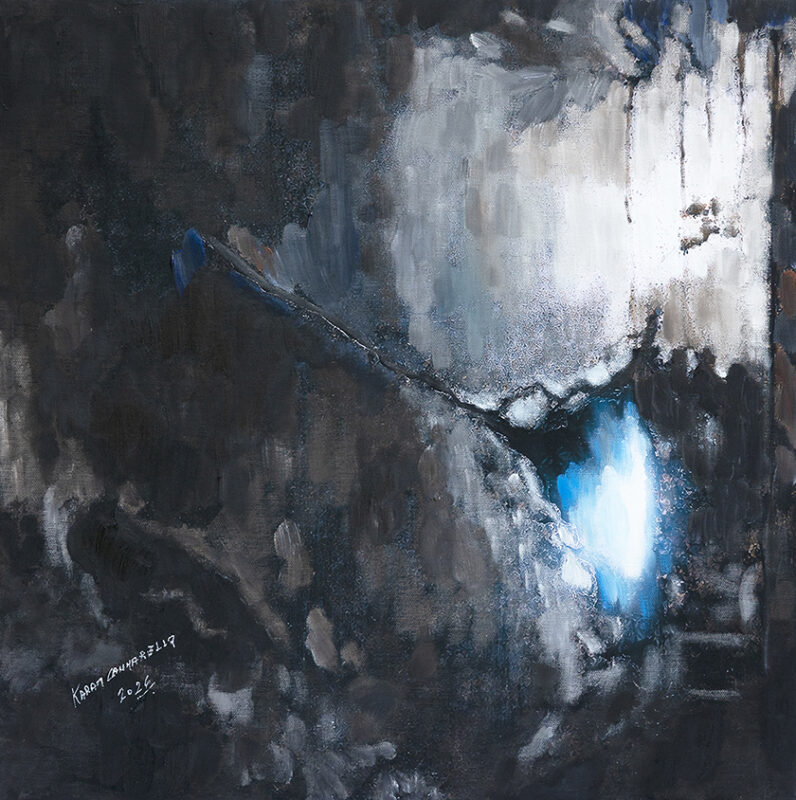
With The wound that holds light, Karam Sebastiano Cannarella brings the path of Restanza to a point of radical essentiality. Every narrative element seems to withdraw to leave space for a painting that reflects on the very matter of existence. There are no figures, nor recognisable places. The image is built around a fracture that crosses the surface and which, instead of representing a definitive laceration, becomes the place where light finds the possibility of manifesting itself.

The wound evoked by the title belongs neither to the register of pain nor to that of loss. It is an opening, a discontinuity that interrupts the apparent compactness of the matter and reveals its depth. Light does not come from the outside to brighten what is dark; it is born from within the fracture itself, as if it were guarded precisely by what seemed to mark an irreparable rupture. Cannarella thus subverts one of the most established images of the symbolic tradition: it is not light that erases the wound, but the wound that makes it visible.

Within the Restanza cycle, this work represents a reflection on vulnerability as a generative condition. To remain does not mean to keep oneself intact, but to accept that every experience leaves an incision capable of transforming our way of inhabiting the world. Permanence does not coincide with passive resistance, but with the possibility of guarding what time has engraved without concealing its traces.

The pictorial construction accompanies this vision with a dense matter, crossed by glazes and sudden chromatic openings. The deep greys, the dark fields and the vibration of blue build a space devoid of stable references, where the surface seems continuously to oscillate between compactness and dissolution. Light does not organise the composition: it crosses it, cracks it, constantly modifies its balance.

The wound that holds light does not propose a reconciliation with pain, nor a sublimation of it. It invites rather to recognise that every fracture guards a possibility of transformation. It is precisely at the point where matter breaks that the image recovers its energy. In this tension between vulnerability and permanence, Cannarella identifies one of the deepest meanings of restanza: the capacity to keep generating light despite the wound, and perhaps precisely thanks to it.

The silence that precedes a work

Many think that a painting is born when the painter takes up the brush. My experience has taught me that it is not so.

A work begins much earlier. It begins in a silence, in a memory, in a light glimpsed for a single instant. Sometimes it is born from a door left ajar, from a chair left empty, from a wall worn by time or from a corner of the sea observed hundreds of times without realising that it held a story.

The artist does not invent the world. He learns to look at it with greater attention.

Every image I make is the result of a wait. I do not seek spectacular effects. I seek that invisible presence that continues to inhabit places even when people are no longer there.

It is from this research that my idea of Restanza was born: what remains when everything seems to have ended. It is not nostalgia. It is memory that continues to live in space.

I would like to invite the reader to do a small exercise. Stop for a few minutes before a place you know well. Do not be in a hurry. Look at the light, the shadows, the marks of time. Ask yourself which lives have passed through there and which emotions that place still preserves.

Perhaps you will discover that every space tells a story. You only need to learn to listen to it.

This is how, at least for me, an image is born.

The echo remains

With The echo remains, Karam Sebastiano Cannarella leads the Restanza cycle towards an even more rarefied dimension, where permanence no longer coincides with matter, but with the capacity of experience to keep resonating beyond its own origin. The work abandons every explicit narrative reference to build a suspended space, in which reality and imagination cease to be distinct categories and become parts of the same interior landscape.

A piano emerges from the waters at the centre of the scene, enclosed between two great velvet wings that seem to open the curtain not onto a theatre, but onto a memory. The domestic interior slowly dissolves into the sea, while the floor loses consistency and lets itself be crossed by the wave. Nothing appears stable. Every element lives in a condition of continuous transformation, where the space built by man returns to confront the primordial force of nature.

The title suggests the key to the entire composition. The echo is what survives the sound without being able to be retained. It no longer belongs to the voice that generated it, nor to the silence that follows. It exists in an intermediate condition, fragile and persistent at the same time. It is precisely this dimension that Cannarella seems to recognise as the most authentic form of restanza: not the persistence of things in their integrity, but the capacity to keep leaving a vibration in time.

The piano too loses its original function. It awaits neither a musician nor a concert. It becomes rather the place of a sonorous memory that continues to exist even in absence. Music is not represented; it is evoked. The viewer is called to listen to what painting cannot show, transforming silence into an integral part of the image.

The pictorial matter accompanies this reflection with an increasingly essential atmospheric construction. Light does not illuminate, but dissolves boundaries; water does not invade the space, it redefines it. The great curtains take on the value of a symbolic threshold between the visible and the invisible, between what happens and what continues to live in memory.

In The echo remains, Cannarella suggests that permanence does not reside in objects, but in the resonances they continue to generate. It is perhaps this the deepest form of restanza: not to hold the past, but to recognise that every authentic experience continues to reverberate within the present, like a sound that time never manages to extinguish.

Restanza is not nostalgia

In recent years there has been much talk of memory, of roots and of abandoned places. Often, however, these themes are associated with nostalgia, as if looking at the past meant simply longing for it. My idea of Restanza is different.

Restanza is not the desire to go back. It is not the regret for what has been. It is the awareness that some places continue to hold a presence even when the people are no longer there.

An empty room, a door left ajar, a chair left in its place, a window through which the light enters. They are simple elements. And yet, they can tell an entire life. Objects preserve traces. Walls hold time. Space becomes a witness.

In my painting the body often disappears. Not because it is less important, but because what remains can speak with an even greater force. Absence becomes a form of presence. Silence becomes narration.

Perhaps we live in an age that runs too fast. We consume images, places and relationships without stopping. Restanza is instead an invitation to pause. To look at what remains. To recognise that memory does not live only in recollections, but also in things, in settings, in the light that keeps falling on the same walls.

Many of my works are born from abandoned houses, from rooms now empty, from forgotten objects. I do not seek the document or the chronicle. I seek that subtle vibration that survives the passing of people.

Restanza is the memory that continues to inhabit places.

It is the time that has not entirely moved away.

It is the light held in space.

The threshold that remained

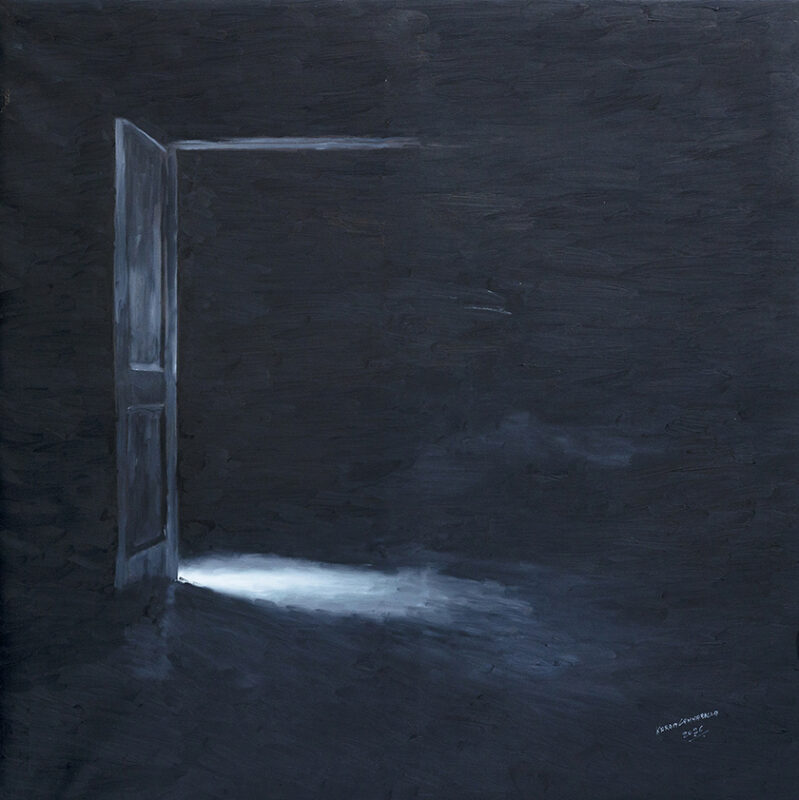
A door left ajar emerges from the darkness. From that opening a beam of light filters through, crossing the floor and dispersing into space. There are no figures, objects or narrative references. And yet, The threshold that remained, one of the most emblematic works of Karam Sebastiano Cannarella’s new Restanza cycle, tells much more than it shows.

The Sicilian artist entrusts to painting the task of investigating what persists after the passing of people and events. If in previous works the body still occupied the scene, here it seems to have dissolved, leaving only the trace of its own existence. It is precisely in this absence that the meaning of the work takes shape.

The threshold has always been a symbol of crossing, change and waiting. Cannarella offers an essential and deeply poetic reading of it. What lies beyond the door does not interest him, nor who opened it. What matters is the passage itself, that subtle boundary between the known and the unknown, between what has been and what could still happen.

Light takes on a central role. It does not illuminate the space to describe it, but transforms it into emotional experience. The contrast between the luminous beam and the surrounding darkness recalls a sensibility that looks to the great tradition of chiaroscuro, while translating it into a contemporary and intimist language. Light becomes presence, memory, possibility.

In Restanza the concept of “remaining” does not coincide with immobility, but with the capacity to guard what time tends to consume. In this painting too, memory is not evoked through narration, but through a sensation. That strip of light seems to hold something we no longer see, but which continues to exist.

With an increasingly essential painting, Cannarella reaches a rare intensity. The threshold that remained is a silent image that invites one to stop and observe. In that small luminous passage the entire meaning of the exhibition is concentrated: the possibility that what is absent continues, in some way, to be present.

Glimmer

With Glimmer, Karam Sebastiano Cannarella brings the reflection on Restanza to a further degree of essentiality. If in previous works memory manifested itself through recognisable presences, objects laden with lived experience or figures that emerged from the pictorial matter as traces of an absence, here everything seems to reduce to a few elements: an open door, a light that invades the space, a pair of abandoned shoes and a series of footprints crossing the floor. And yet, precisely in this subtraction, the image acquires an extraordinary evocative intensity.

The setting appears almost emptied. The dark walls absorb the gaze, transforming the space into a mental dimension before even a physical one. The light that bursts in from outside does not simply illuminate the room: it crosses it, engraves it, redefines its perception. It is a living presence, capable of building a narrative tension without needing to show any protagonist.

What tells of what happened are the traces. The footprints that follow one another on the floor constitute the silent axis of the composition. We do not know to whom they belong, nor whether they lead inward or outward. This ambiguity becomes the heart of the work. The footprints record a passing, they bear witness to a presence now absent, but at the same time they continue to indicate a possibility. They are memory and movement, permanence and transformation.

Beside them, the abandoned high-heeled shoes introduce a deeply human dimension. They do not appear as simple objects, but as residues of a story that the painting deliberately leaves incomplete. Cannarella does not build a narration to decipher; he offers rather fragments through which the viewer is called to confront their own experience of waiting, of loss.

The title orients this reading. The glimmer does not coincide only with the physical opening of the door. It is a condition of the gaze. It represents that subtle margin through which something continues to enter our life even when it seems to have gone. It is the possibility that light finds a passage in the darkness, but also that the past continues to dialogue with the present without ever being completely exhausted.

Within the poetics of Restanza, the work takes on a particularly emblematic meaning. To remain is not here synonymous with immobility. The footprints bear witness that someone has moved, that a choice has been made, that a threshold has been crossed. And yet, something continues to persist. Not the body, not the figure, but the sign of the passage, the memory of a presence that still inhabits the space.

In this suspended space, between shadow and light, between departure and permanence, the artist seems to suggest that the true restanza does not concern what remains motionless, but what continues to leave a trace of itself even after having passed beyond.

After work

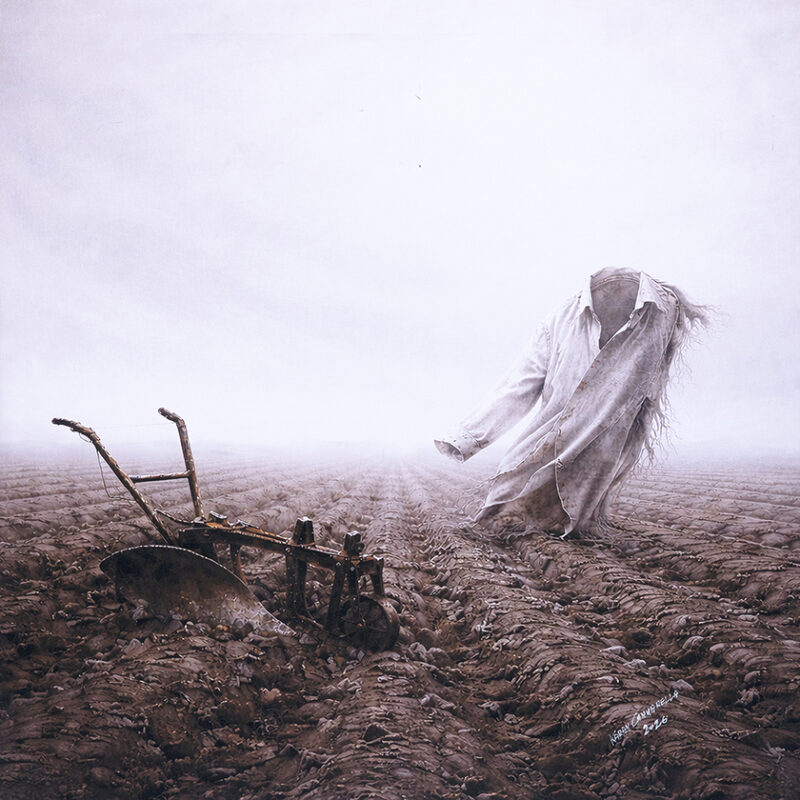
After work represents a decisive moment in the path through restanza that Karam Cannarella is building work after work. If in previous works persistence manifested itself as threshold, waiting or identity tension, here it takes on a deeper and more universal dimension, tied to the relationship between body, memory and landscape.

The scene is dominated by a silent vastness. A ploughed field extends until it dissolves into a milky fog that erases the horizon. In this suspended space, an abandoned plough and a faceless figure constitute the two poles of the composition. It is not, however, a representation of agricultural labour, nor a social narrative. What interests the artist is what remains when the action is over, when the gesture has been consumed and the body seems to have withdrawn, leaving a trace behind it.

The figure that crosses the field appears as a presence at once fragile and stubborn. The face is absent, erased or perhaps returned to the same atmospheric matter that envelops the landscape. The white garment, pushed by a barely perceptible wind, seems to float above the earth, as if it belonged simultaneously to the world of the living and to that of memory. There is no dramatic emphasis. On the contrary, the image builds a stillness that contains within itself a subtle disquiet.

In After work restanza manifests itself as persistence. It is no longer the remaining on the threshold of a transformation, but the persistence of things beyond their function. The plough has ceased to cut the ground, the labourer is no longer recognisable, and yet something continues to be present. It is the memory of the gesture that settles in the space and modifies its perception. The earth preserves the passage of labour just as the body preserves the experience of time.
The composition accentuates this dimension. The long furrows of the field lead the gaze towards a point that is never reached. The perspective promises a destination that the fog immediately denies. Here too, as in other works by the author, meaning does not coincide with the landing but with the journey. The gaze is called to pause, to inhabit a distance that cannot be bridged.

The chromatic choice contributes to this suspension. Earthy and dusty tones dominate the surface, while the white of the garment emerges as an almost immaterial presence. There is no spectacular contrast, but a slow modulation of values that transforms the landscape into a mental space before even a physical one.

After work seems then to question what survives the action, what remains when doing is interrupted and the world returns to silence. In this image Cannarella neither celebrates labour nor records its end. He investigates rather that intermediate zone in which presence continues to manifest itself through absence, and where restanza reveals itself as a form of resistance of memory against the dissolution of time.