Author Archives: Karam

What light tells us

Light does not only serve to see: the secret of shadow between Caravaggio and Turner.

Light does not only serve to see.

It seems a simple, almost obvious statement, and yet much of the history of painting could be told starting precisely from this idea. Light shows things, certainly, but at the same moment it transforms them. It decides what we can see and what must remain in shadow. It draws near, moves away, reveals, hides.

When I paint, I never think of light as a decorative element. For me light is a presence.

I learned to know it very early, before the sea of Portopalo. Those who grew up by the sea know that light is never the same. It changes continuously. In the morning it can be sharp, almost cruel. In the afternoon it becomes heavier. At sunset it seems to hold things back for a few moments before letting them disappear.

As a child I did not know, of course, that all this would have to do with painting. I looked.

And perhaps a painter begins exactly like this: looking at something without yet knowing why he will keep remembering it all his life.

Over the years I understood that light does not simply illuminate a face, a wall, a door or the sea. It questions them.

Let us think of Caravaggio. His light does not enter the scene to allow us to see better. It arrives like an event. It touches a face, a hand, a body, and suddenly that detail becomes necessary. Everything that remains around it can sink into darkness.

Turner makes almost the opposite movement. Light no longer strikes things: it seems to dissolve them. The sea, the sky, the ships and the horizon slowly lose their boundaries. What remains is an atmosphere in which we no longer know for certain where the world ends and where light begins.

They are two very different ways of painting, but both remind us of something: light is not neutral.

It is the same in life.

There are moments in which we suddenly see something that had always been in front of us. A person, a place, even a familiar object take on a different meaning. They have not changed. What has changed is the light with which we look at them.

Perhaps this is why, as the years have gone by, my relationship with painting has changed.

For a long time I painted the figure. The body was at the centre of the scene. I needed its presence, the gesture, the flesh, the gaze.

Then, slowly, something shifted.

I began to be more interested in what remains when the figure is no longer there: a room, a half-open door, a wall, a trace, a strip of sea.

And it is precisely then that light became even more important.

When we remove the figure, in fact, we do not necessarily remove the presence.

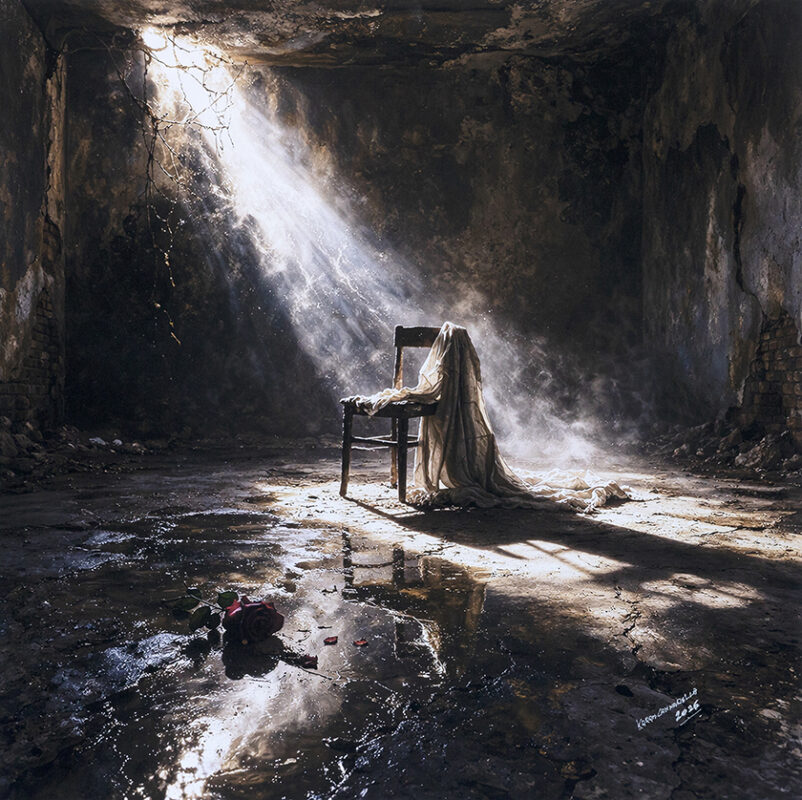
A blade of light crossing an empty room can tell of someone we do not see. An illuminated door can suggest a waiting. A wall struck by the sun can hold a memory. An almost erased horizon can make us feel a distance.

Painting must not always explain.

On the contrary, I believe that one of its deepest tasks is to leave something without an answer.

We live in a time that claims to show us everything. Images come continuously before our eyes. They are bright, immediate, perfect. They tell us where to look and often even what we should feel.

Painting can do the opposite.

It can ask for time.

It can leave a zone of shadow.

It can allow us not to understand immediately.

When, in front of a painting, we wonder where that light comes from, what lies beyond a door or why part of the canvas has remained almost in darkness, in that moment we have already begun to take part in the work.

We are no longer simply spectators.

We are looking.

And it is an enormous difference.

Today I look for a light that does not erase the darkness. I need both. A completely illuminated canvas risks having no more secrets; a completely dark canvas risks granting us no possibility.

Between these two conditions there is a subtle space.

It is there that I am interested in painting.

The light that crosses time

There are lights that illuminate and lights that remember.

In my painting light is never merely a natural fact. It does not simply serve to make a figure, a wall, the sea or a door visible. It is something that comes from farther away. It crosses time, meets what has remained and, for an instant, gives it back a presence.

I have always thought that time does not truly erase things. It transforms them. It leaves traces, wears out colours, empties rooms, takes people away. But something remains.

It is precisely in that little that remains that I seek my painting.

When I paint an empty place, I do not think it is truly empty. Someone passed through there. Someone opened that door, looked at that sea, laid a hand on that wall. Perhaps we will never know who they were, but their absence continues to inhabit the space.

Light then enters like a memory.

It does not tell everything. It does not explain. It grazes.

It can be a clear blade crossing a room, a glimmer on the sea, a suddenly luminous area within a darker sky. I am interested above all when it seems to arrive from a place we do not see.

It is a light that does not belong only to the present.

Perhaps for this reason, in recent years, the human figure has progressively given way in my paintings. For a long time I painted the body, the face, the gesture. Today I am also interested in what comes after: what remains when the body is no longer there.

From this research Restanza was born.

To remain, for me, does not mean to be motionless. It means to continue to exist in another form. A door left ajar, a forgotten object, a marked wall, a sea horizon can contain more memory than a directly represented figure.

Light makes this permanence visible.

In Portopalo, where I was born, I learned very early to look at it. The light on the sea is never the same. It changes continuously and at the same time seems very ancient. It is the same light the fishermen saw, those who departed and those who waited on the shore. It passed over the boats, the tuna fisheries, the houses and the people who are no longer here today.

When I return before that sea, I feel that present and past can stand in the same instant.

Perhaps this is what I seek when I paint.

I do not want to reconstruct what has been. I do not want to tell the past like a photograph. I seek rather the point where the past continues silently to live in the present.

And light is the passage.

It crosses the years without belonging to anyone. It touches what is born and what disappears. It reveals something for a moment and immediately after lets it return into silence.

Even when I address the sacred, it is this light that I seek. Not a spectacular or decorative light, but a restrained presence. Something that suggests without declaring, that leaves the viewer the space to feel.

Because I believe that painting must not always give answers.

Sometimes it must only open a threshold.

Before a painting I would like the one who looks to be able to stop and have the sensation that something has just happened, or that it is about to happen. We do not know what. We see only a trace, a shadow, a light.

The rest belongs to our memory.

At eighty-four the meaning of time inevitably becomes different. I do not consider it only as something that passes. I see it as a matter that deposits itself within us. Every encounter, every journey, every person known, every place left continues in some way to accompany us.

Painting allows me to bring all this back to the surface without having to tell it directly.

A colour, an emptiness, a threshold can contain many years.

And then the light arrives.

It crosses the painting as it crosses life: for a moment it makes visible what we believed lost.

Perhaps this is the reason why I keep painting.

To seek, within what remains, that small light capable of crossing time.

The art of staying, to learn to see

We live in a time that continually invites us to go elsewhere. We rush, we change, we consume every experience in the hope that the next one will be better. And yet art has taught me a different lesson: sometimes the greatest discovery is born precisely from staying.

To stay does not mean to come to a halt. It means granting time the possibility of revealing what a hurried glance does not see. A wall worn by salt, a half-open door, an empty chair, the silence of a room: these are images that, if observed with patience, become memory, presence, story.

“The painter does not invent the light. He waits for it. He recognises it when it crosses a window, when it caresses a wall or when the sea changes colour without making a sound.”

In that instant he understands that beauty is not a special effect, but an encounter.

Perhaps we too should learn to live like this. To stop a few minutes longer in front of what seems ordinary. To listen to the silence of a place. To notice the traces left by those who came before us. It is right there that memory is born, and it is from memory that hope is born.

Art does not serve to decorate the world. It serves to remind us that every place holds a soul, and that every person can learn to recognise it if they find the courage to look carefully.

When a place knows memory

There are places that are not only spaces. They are presences. They hold time without retaining it, like a stone that keeps preserving the warmth of the sun even after sunset.

Entering certain settings one has the sensation that someone has just left. It is not the people who remain, but their passing. A chair slightly moved, a door left ajar, a wall worn by the light, a drape that stirs faintly. They are minimal traces, yet capable of telling more than any figure.

Memory does not dwell only in human beings. It lives in places too.

Every house, every church, every harbour, every room crossed by life preserves something that cannot be measured. It is a silence that speaks. It is time that settles slowly upon things.

Perhaps it is precisely here that my painting is born.

I do not paint nostalgia. I seek permanence. I seek what remains when the noise moves away. Every painting is the attempt to make an invisible presence visible, to show that absence is never an absolute void.

Light then becomes the true face of memory. It does not only illuminate objects: it gives them back a story.

This is Restanza: not stopping for fear of leaving, but recognising the value of what continues to live in the places we have loved.

When a place knows memory, it is no longer only a place. It becomes a testimony. And art, perhaps, does nothing but listen to that testimony and transform it into light.

Light is in no hurry

We live in a time that demands immediate results. Everything must appear, convince, be consumed in a few instants. Art too often seems forced to chase this speed. And yet light knows no hurry.

Light arrives when it finds a space ready to welcome it. It crosses a window, brushes a wall, settles on an empty chair and, without making a sound, transforms what seemed insignificant into a presence.

This is what I seek in my painting.

I do not chase the spectacular effect. I look for that silent instant in which time slows down and things breathe again. A half-open door, a table, the motionless sea, a shadow that slowly becomes memory. In those places light does not only illuminate objects: it illuminates what has remained inside us.

Restanza is born precisely from this waiting. To stay does not mean to come to a halt, but to have the courage to wait for a place, a wound or a memory to find their voice again. Light knows this patience. It never forces the darkness; it crosses it with delicacy.

Perhaps this is why the most authentic works are not understood in a single glance. They ask for time. The same time with which light enters a house at dawn or accompanies the sunset over the sea. A time that does not demand, but gives.

We too, in life, should learn from light. Not to be in a hurry to understand everything, to arrive everywhere, to give an answer at once. Some truths ripen slowly, like a canvas built up brushstroke after brushstroke.

Light is in no hurry because it knows that what is destined to remain is not born in urgency, but in patience.

And perhaps this is the deepest lesson of art: not to teach us to look more quickly, but to look more deeply.

Looking is not enough, you must know how to see

Every day we pass in front of hundreds of images. We observe them for an instant and then we forget them. It is the fate of a world that runs too fast. But art asks the opposite: it invites us to slow down.

Learning to look means granting time to things. An old peeling wall can tell more than a monument. A half-open door can speak of someone who has just left or of someone who will never return. An empty chair does not represent an absence, but a presence that keeps living in memory.

When I paint I never try to copy what I see. I seek what remains after the superficial glance has passed. It is there that the work is born.

Many people ask me why in my works the spaces seem inhabited even when no human figure appears. The answer is simple: people pass, places remember. Every room keeps a fragment of life, every object holds a gesture, every light retains a story.

The artist does not invent these stories. He listens to them.

This is why I invite you too to do a small exercise. Stop in front of a place you know well: a square, a window, the sea, an old house. Stay silent for a few minutes. Do not look for anything extraordinary. Let that place speak.

Perhaps you will discover that seeing does not only mean using your eyes. It means learning to listen to the memory hidden inside things.

It is from this listening that art is born. And it is from this listening that, sometimes, a new part of ourselves is born too.

How an image is born

Viviamo circondati da immagini. Le scorriamo sui telefoni, le incrociamo per strada, le dimentichiamo pochi istanti dopo. Eppure le immagini che rimangono dentro di noi non sono necessariamente le più spettacolari. Sono quelle che abbiamo davvero imparato a guardare.

Guardare non significa semplicemente vedere. Vedere è un gesto automatico; guardare è una scelta. Richiede tempo, silenzio e disponibilità a lasciarsi sorprendere.

Molte delle mie opere non nascono davanti a una tela, ma molto prima. Nascono da una porta socchiusa, da una sedia rimasta vuota, da un muro consumato dal tempo, da una luce che entra in una stanza. Sono dettagli che quasi tutti ignorano, ma che custodiscono una storia.

L’artista non inventa il mondo: lo ascolta. Cerca ciò che resta quando il rumore si allontana. In quel momento un luogo diventa memoria, un oggetto diventa presenza e un’assenza comincia a parlare.

Vi propongo un piccolo esercizio. Fermatevi per qualche minuto in un luogo che conoscete bene. Non cercate qualcosa di straordinario. Osservate la luce, le ombre, le tracce lasciate dal tempo. Chiedetevi quale storia raccontano.

Forse scoprirete che le immagini più profonde non sono quelle che cercano di colpirci, ma quelle che ci aspettano pazientemente, fino a quando impariamo davvero a guardarle.

The house as an archive of memory

There are places that never stop speaking to us. Even when they are empty, even when time seems to have come to a standstill, they keep holding something invisible.

The house is one of these places.

I am not speaking of the house as a mere building, but of the house as a repository of lives, of gestures, of affections. Every room keeps traces. A table, a chair, a curtain stirred by the wind, a bottle forgotten on a shelf can tell a story more than many words.

In my artistic research the house has become, over the years, a place of memory. Not a museum of the past, but a space in which time keeps being present. People disappear, objects remain. And it is precisely in this permanence that the feeling I try to paint is born.

Many of my most recent works are born from empty rooms. There are no human figures. There are no events to recount. And yet something happens. The space holds a presence. The light seems to keep a memory.

Perhaps today we are afraid of silence. We fill every moment with images and information. But memory needs slowness. It needs places in which to stop.

When I enter the Artist’s House in Portopalo di Capo Passero I do not see only walls and furniture. I see a life that keeps speaking through the things that have remained. Every object is a testimony. Every room is a page.

Painting, for me, is born precisely from this listening.

To paint means to give form to what can no longer be seen, but which keeps existing in the memory of places.

The house thus becomes a silent archive of time. And the artist does nothing but try to make its breath visible.

Karam Cannarella

10/07/2026 Il Giornale OFF

[/ux_text] [/col] [/row]

Waiting for light

With Waiting for light, Karam Sebastiano Cannarella introduces into the Restanza cycle a reflection on the time of waiting, understood not as passive suspension, but as a form of permanence. The work renounces every narrative definition and builds a space in which painting becomes a sensory experience of flowing. There are no precise coordinates, nor a horizon capable of orienting the gaze. Everything seems to belong to a single liquid matter, crossed by a presence that emerges without ever imposing itself.

At the centre of the composition, a dark form surfaces from the water like a body suspended between immersion and emergence. It is not important to establish its identity. Cannarella does not seek the recognition of the image, but the condition it embodies. That figure is neither sinking nor resurfacing: it inhabits a fragile balance, entrusting itself to the very movement of the water. It is a presence that resists not by opposing the current, but by letting itself be crossed by it.
The title suggests the direction of the reading. The waiting does not concern the arrival of light as an external event. It is rather the inner disposition of one who keeps recognising its possibility even when everything seems immersed in uncertainty. Light, indeed, does not burst into the scene. It spreads slowly through the pictorial matter, transforming the deep blues into a vibrant surface, where every tone seems to hold a promise of brightness.

Within the poetics of Restanza, this work introduces a dimension of trust. To remain also means to accept the time necessary for something to manifest itself again. Permanence does not coincide with the wait for a solution, but with the capacity to inhabit the unfinished without losing the sense of direction. It is a silent choice, which renounces urgency in order to recognise value in the time of maturation.

Painting accompanies this vision through an essential construction, where the gesture becomes more gathered and the matter seems to breathe together with the water. The glazes, the transparencies and the sudden chromatic densities dissolve every boundary between figure and environment, letting colour itself generate the movement.

In this sense, Waiting for light does not narrate a landing, but the moment that makes it possible. Light is not yet fully present, and precisely for this reason it continues to exert its force. Cannarella suggests that restanza is not born from the certainty of what will come, but from the capacity to guard a hope even when its horizon remains invisible. It is in this discreet tension, made of trust and abandonment, that the work finds its most authentic intensity.

The time of images

We live in a time in which images are born and disappear with the same speed with which we scroll a screen. We see thousands of them, but few truly manage to inhabit our memory. Perhaps because we do not grant them the time necessary to enter within us.

I believe instead that every true work of art has its own time. Not the time of the clock, but that of waiting, of silence and of encounter. An authentic image does not impose itself: it waits. It stays there, discreet, until we are ready to welcome it.

When I paint I do not seek the immediate effect. I seek a presence that continues to live even when the painting has been left. It is in that moment that the deepest dialogue between the work and the one who observes it is born.

Painting is not only what is seen. It is what remains after having looked. It is a trace that keeps working within us, often without our noticing.

This is why I speak of Restanza. To remain does not mean to stop, but to guard what deserves not to be forgotten. Every image should have the courage to slow down time, to withdraw us for an instant from daily haste and to hand us back to silence.

Perhaps the task of art today is not to produce more images, but to give time back to images. Time to be looked at, understood and loved. Because only what finds the time to inhabit our heart can be transformed into memory.