


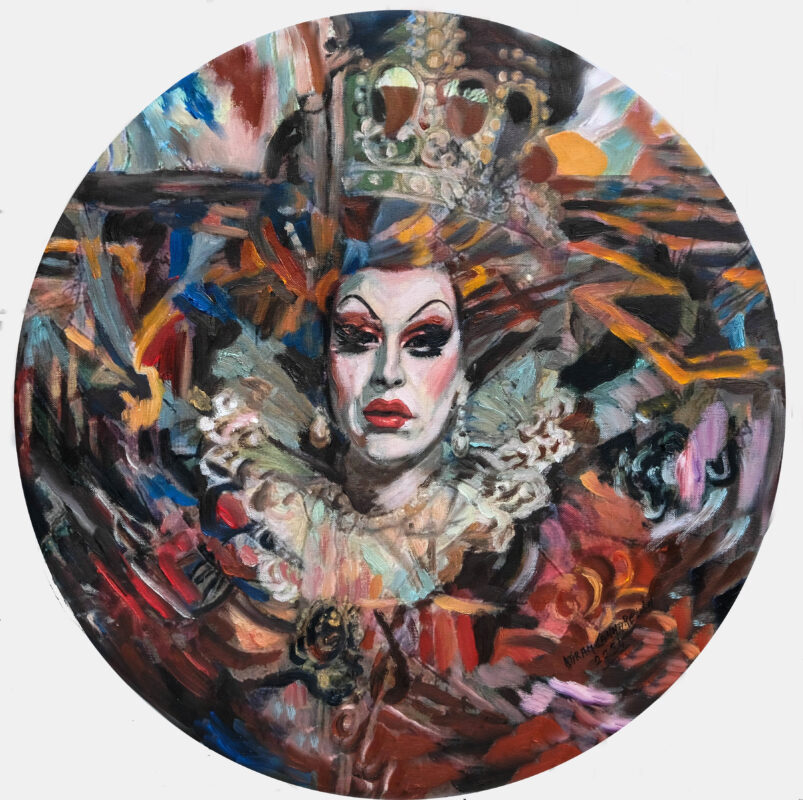
The Queen of the Labyrinth condenses into a circular format a tension that runs through all of Karam Cannarella’s recent research: that between identity and dispersion, between presence and loss. The face emerges at the centre of the composition like a held apparition, frontally exposed to the gaze, but immediately sucked in by a pictorial vortex that seems to dissolve every possibility of stability.
The round support is not a simple formal element. It functions as a perceptual device, eliminating hierarchies and privileged directions. There is no true vanishing point: everything rotates, thickens, returns. The central figure, with the marked make-up and the almost hieratic fixity of the expression, thus takes on an ambiguous presence. A queen, certainly, but of an unstable realm, crossed by fragments, slippages, visual interferences that prevent any idea of dominion.
The labyrinth evoked by the title does not appear as an architectural space to be crossed, but as a mental and affective condition. It is an internal dimension that invests the very body of the image. Painting proceeds indeed by accumulations and chromatic collisions: rapid brushstrokes, sudden luminous openings, signs that emerge and immediately lose themselves within the matter. Nothing lets itself be fixed definitively. Even the face, though central, seems continuously to oscillate between emergence and fading.
In this work the concept of restanza, which progressively defines itself in the author’s poetics, takes on a further quality. It no longer coincides only with remaining within a threshold or a tension, but with inhabiting a complexity that cannot be recomposed. To remain thus means to accept disorientation without transforming it into trauma nor into solution. The figure does not seek an exit from the labyrinth; it crosses it by standing still, as if movement occurred all around her.
The performative component, recurrent in Cannarella’s research, here loses every narrative dimension to become pure visual intensity. The make-up, the ornaments, the theatricality of the image do not function as masks behind which to hide, but as surfaces through which the subject takes form.
It is a work that holds the gaze precisely because it refuses to give itself completely, letting emerge a presence that continues to change while we observe it.
Paola Martino