


With Restanza, Karam Cannarella inaugurates a new trajectory of his research, shifting the gaze towards a more gathered and radically essential dimension of remaining. If in previous works the figure seemed to inhabit unstable territories of identity, immersed in processes of exposure, transformation and dispersion, in this new production the tension concentrates around a more silent gesture: that of keeping.
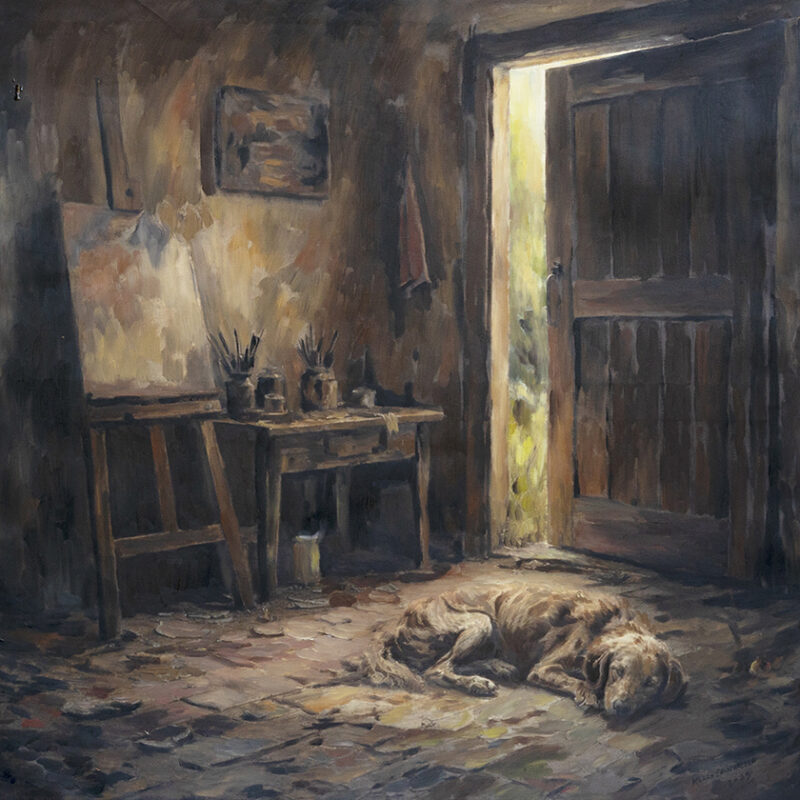
In The last keeper, painting opens onto a suspended interior, a space at once domestic and mental, crossed by traces of presence that seem to resist the erosion of time. The easel, the brushes, the worn table do not merely define a setting; they become fragments of an operative memory, clues of a doing that continues to exist even in absence. Every element appears held in a slow temporality, as if something had just happened or had yet to be accomplished.
At the centre of the work, the reclining body of the dog introduces a presence that escapes every easy allegory. A keeper, certainly, but not in the heroic or vigilant sense of the term. Its gathered posture suggests rather a quiet fidelity, a form of discreet resistance that manifests itself through waiting. It is a presence both vulnerable and necessary: it remains when everything seems to have withdrawn, it inhabits a space that no longer protects anything except the very possibility of remaining.
The door left ajar, invaded by light, organises the symbolic tension of the image. It represents neither a landing nor a promise of escape. It is an open threshold, the point where inside and outside brush against each other without resolving. In this tension the poetic core of Restanza is articulated: to remain does not mean to immobilise oneself, but to sustain the conflict between what holds and what inevitably calls elsewhere.
The concept of restanza, in Cannarella’s research, thus frees itself from every nostalgic interpretation. It does not coincide with the refusal of change, but with the choice — fragile and stubborn — to inhabit what remains without withdrawing from precariousness. The last keeper tells neither of an end nor of an abandonment; it stages rather a form of minimal and resistant presence, a condition in which even silence becomes a gesture of care.
Painting thus becomes a place of emotional sedimentation: less theatrical, more atmospheric, capable of holding light and time. In Restanza, what survives is not certainty, but the subtle relationship with what continues, despite everything, to ask to be kept.
Paola Martino