


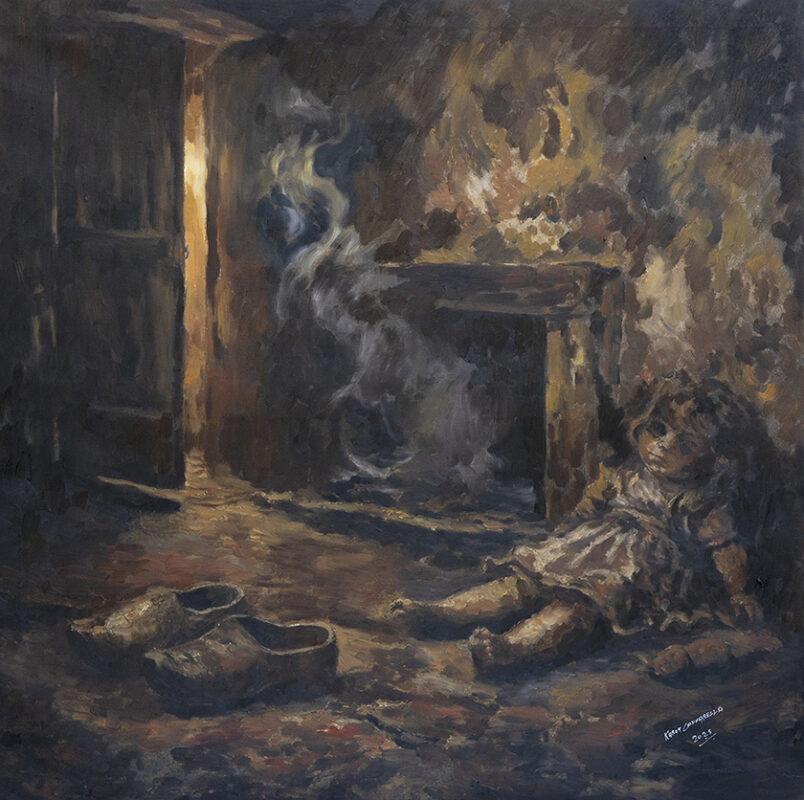
With Fire does not forget, Karam Cannarella continues the reflection begun in the Restanza cycle, venturing into a territory where memory, loss and permanence intertwine in a narration suspended between reality and vision. The work presents itself as a bare, almost abandoned interior, crossed by a subtle light that filters through the door left ajar. And yet, what emerges is not the description of a place, but the materialisation of a presence that continues to exist beyond its own absence.
At the centre of the composition there is not a human figure, but a doll forgotten on the floor. Its inert body, beside a pair of worn clogs, immediately introduces a domestic and affective dimension. They are objects that carry with them the weight of lived experience, fragments of a daily life now interrupted that the painting returns as relics of a time not completely passed. Nothing appears truly concluded: every element seems to retain the trace of those who inhabited it.
The most disturbing element of the work is, however, the evanescent presence that rises beside the table. A figure barely sketched, built through glazes and chromatic fades, emerges from the pictorial matter like a memory that refuses to disappear. It is not a ghost in the narrative sense of the term, but a condensation of memory itself. Cannarella does not represent absence; he paints its persistence.
The title orients the reading without exhausting it. The fire it alludes to is not only that of destruction, but also that of memory that keeps burning beneath the surface of time. If fire transforms everything it crosses, it nonetheless leaves traces, sedimentations, residues that resist oblivion. In this sense the work fully inscribes itself in the concept of restanza that runs through the artist’s recent research: what remains does not coincide with what survives intact, but with what continues to manifest itself in new forms, often fragile and imperfect.
The open door, recurrent in Cannarella’s most recent production, takes on a further function here. It is a threshold between the visible and the invisible, between what belongs to the present and what continues to resurface from the past. The light that filters in from outside does not dissolve the shadows; on the contrary, it makes them perceptible, giving consistency to what seemed lost.
Through a dense and atmospheric painting, made of chromatic stratifications and luminous vibrations, Fire does not forget builds an emotional space in which memory does not present itself as simple nostalgia, but as active presence.
The work invites the gaze to pause in that uncertain zone where memory continues to generate images, reminding us that some traces do not ask to be preserved: they simply do not stop existing.
Paola Martino