


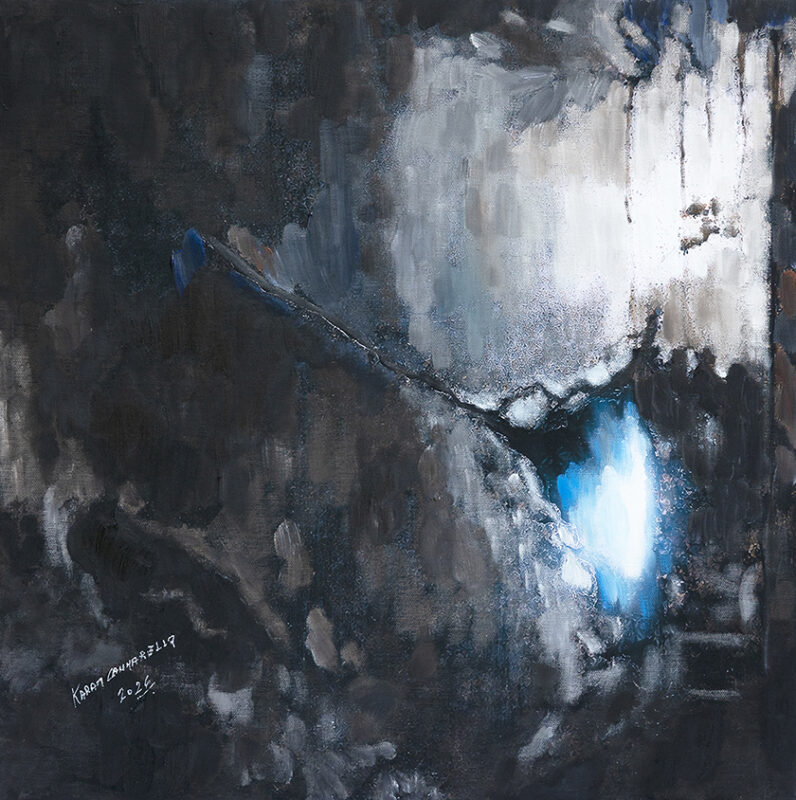
With The wound that holds light, Karam Sebastiano Cannarella brings the path of Restanza to a point of radical essentiality. Every narrative element seems to withdraw to leave space for a painting that reflects on the very matter of existence. There are no figures, nor recognisable places. The image is built around a fracture that crosses the surface and which, instead of representing a definitive laceration, becomes the place where light finds the possibility of manifesting itself.
The wound evoked by the title belongs neither to the register of pain nor to that of loss. It is an opening, a discontinuity that interrupts the apparent compactness of the matter and reveals its depth. Light does not come from the outside to brighten what is dark; it is born from within the fracture itself, as if it were guarded precisely by what seemed to mark an irreparable rupture. Cannarella thus subverts one of the most established images of the symbolic tradition: it is not light that erases the wound, but the wound that makes it visible.
Within the Restanza cycle, this work represents a reflection on vulnerability as a generative condition. To remain does not mean to keep oneself intact, but to accept that every experience leaves an incision capable of transforming our way of inhabiting the world. Permanence does not coincide with passive resistance, but with the possibility of guarding what time has engraved without concealing its traces.
The pictorial construction accompanies this vision with a dense matter, crossed by glazes and sudden chromatic openings. The deep greys, the dark fields and the vibration of blue build a space devoid of stable references, where the surface seems continuously to oscillate between compactness and dissolution. Light does not organise the composition: it crosses it, cracks it, constantly modifies its balance.
The wound that holds light does not propose a reconciliation with pain, nor a sublimation of it. It invites rather to recognise that every fracture guards a possibility of transformation. It is precisely at the point where matter breaks that the image recovers its energy. In this tension between vulnerability and permanence, Cannarella identifies one of the deepest meanings of restanza: the capacity to keep generating light despite the wound, and perhaps precisely thanks to it.
Paola Martino